Mobile home park investors have quietly benefited from a utility billing advantage for decades. Buy electricity or water at commercial bulk rates, install submeters or use ratio billing, pass the cost to residents — and keep the spread. It was legal, common, and profitable.
That model is under serious threat. And if you haven’t audited your parks’ billing practices recently, you might be sitting on a regulatory time bomb you don’t even know is ticking.
The Ohio Ruling That Changed Everything
On April 22, 2026, the Ohio Supreme Court issued a unanimous ruling: submetering companies are public utilities. They must be regulated by the Public Utilities Commission of Ohio. The case involved Nationwide Energy Partners (NEP) — one of the largest submetering operators in the country — and the implications ripple far beyond Ohio’s borders.
What the court found was straightforward: if you source electricity, install distribution equipment, bill tenants directly, and disconnect service for non-payment — you’re operating like a utility. You should be regulated like one.
The ruling dismantles the financial model many operators built around unregulated utility resale. The markup that operators or their billing companies charged? Now subject to rate review. The consumer protections utilities must provide — low-income payment plans, disconnection moratoriums — now apply to submetered tenants in Ohio.
Other states are watching. Several are already moving.
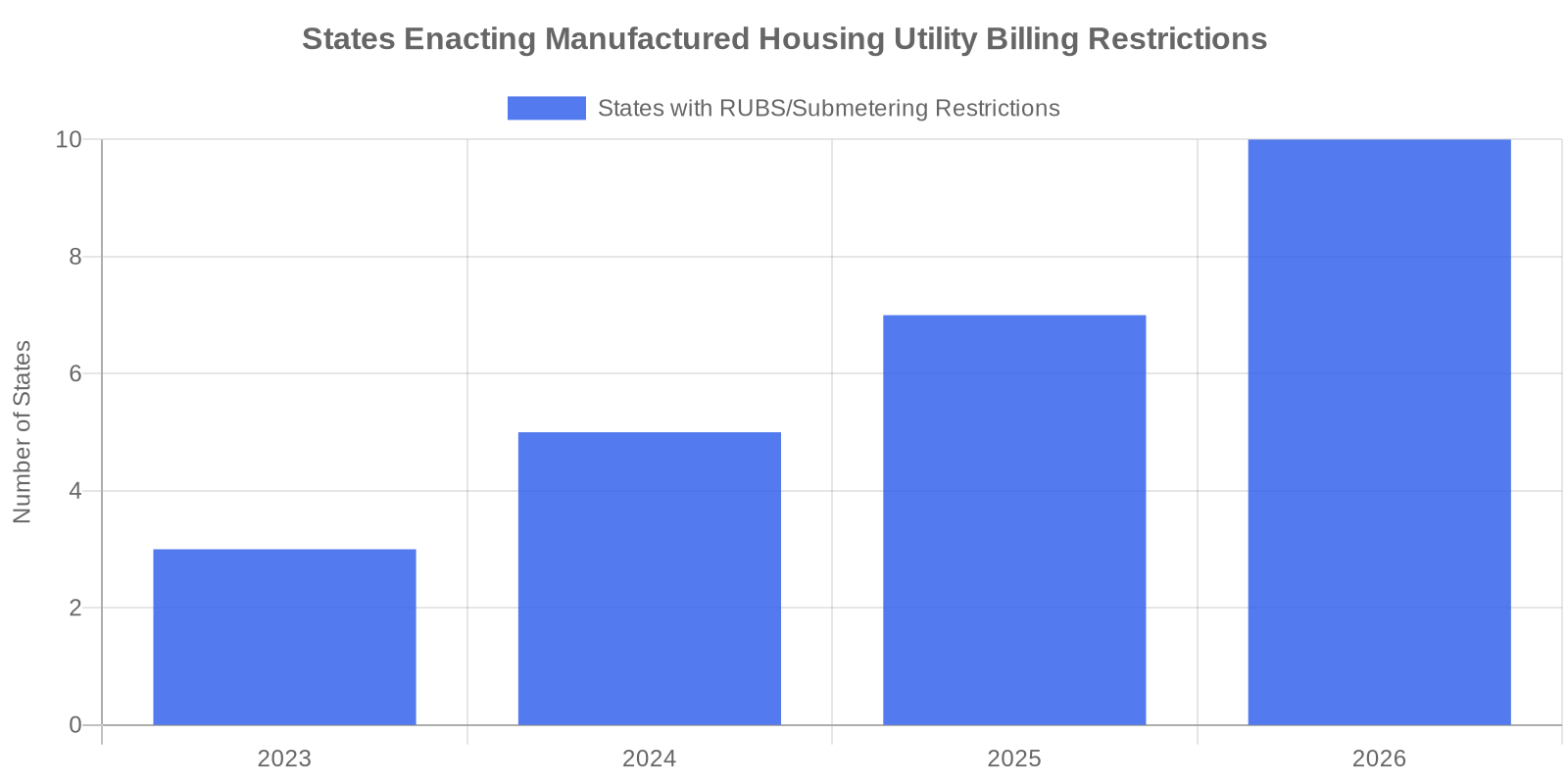
The RUBS Problem Is Bigger Than Ohio
RUBS — Ratio Utility Billing Systems — is the practice of taking a single master utility bill and dividing it proportionally across all residents based on square footage, occupancy, or some other formula. If you run RUBS in your parks, your legislative exposure map is growing fast:
- Minnesota — Has moved to restrict or ban RUBS in manufactured housing communities
- Colorado — Enacted requirements for greater billing transparency and individual metering mandates for new construction
- California — CPUC has asserted jurisdiction over submetered properties, with active consumer protection proceedings
- Washington — Park owners facing legislation and resident lawsuits over RUBS practices
- Arizona — State AG issued consumer alerts; class action litigation active after billing errors resulted in residents receiving bills 800% above normal
The pattern is clear: what was legally gray three years ago is becoming either prohibited or heavily regulated. And unlike zoning changes that take years, utility billing legislation can move quickly once a consumer complaint campaign gets traction.
What’s the Real Financial Risk?
Let’s be concrete. If you run a 100-lot park where RUBS generates $200/month in net utility recovery per unit, that’s $20,000/month — $240,000/year — in revenue. If your state bans RUBS and you have to absorb the master meter cost or convert to direct billing, you’ve just lost that income stream or taken a six-figure capital expenditure hit to convert.
Individual submetering — the compliant, defensible alternative — costs $800–$2,500 per pad installed. For a 100-lot park: $80,000–$250,000 in conversion capital. For operators who didn’t budget this, it’s a serious problem. For operators who bought parks modeled around RUBS revenue, it can flip a deal from profitable to break-even.
And that’s before the litigation exposure. Class-action suits for “overbilling” are active in multiple states. If your billing practices can be characterized as consumer fraud — even inadvertently — you’re looking at damages that dwarf the utility revenue you ever collected.
This is exactly the kind of line-item risk that catches operators off guard during acquisition. If you’re evaluating a mobile home park purchase, the Keel Team Due Diligence Playbook covers utility billing audit steps in depth — it’s worth a read before you go under contract.
The Solution: Get Ahead of This Now
Here’s what we recommend for every mobile home park operator in 2026:
1. Audit every park’s billing method today
Know exactly what billing model is in use at each property — individual submetering, RUBS, master-metered absorbed, or direct pass-through. Create a simple spreadsheet. You need this before you can assess risk.
2. Map your states’ regulatory status
The National Conference of State Legislatures (NCSL) tracks utility submetering legislation by state. Cross-reference your park locations. If you’re operating in Ohio, California, Minnesota, Washington, Arizona, or Colorado — prioritize immediate review.
3. Consult your billing company — but verify independently
Billing companies have a vested interest in telling you their model is compliant. Get an independent legal opinion in any state where you have significant utility recovery revenue at stake.
4. Model the conversion cost
If you’re running RUBS in a high-risk state, run the numbers on conversion to individual submetering now — while it’s planned capital expenditure, not emergency response. Planned conversion is 30–40% cheaper than reactive conversion.
5. Update your leases
Many operators are transitioning to a direct “utility cost pass-through” model in lease agreements — where residents pay their actual consumption plus a documented and capped administrative fee. This is cleaner than resale and survives regulatory scrutiny in most states.
The Silver Lining for Operators Who Move First
Individual submetering isn’t just a compliance play. Parks that convert consistently see utility consumption drop 20–40% as residents become accountable for their own usage. Water leaks get caught faster. Residents have an incentive to conserve. The parks that convert now will have lower operating costs, cleaner resident relationships, and a compliance story that plays well with institutional lenders and buyers.
This is one of those situations where the operators who move proactively will be positioned significantly better than those who wait to be forced.
At Keel Team, we’ve already audited each park in our portfolio against its state’s current regulatory environment and are prioritizing conversions in the states moving fastest. If you’re evaluating mobile home park acquisitions, make sure your due diligence specifically addresses utility billing compliance — it’s a line item that can quietly destroy your underwriting.
The time to act is before the law changes in your state. Not after.
Keel Team invests in and operates mobile home parks across the Southeast and Midwest. For educational content on mobile home park investing, visit keelteam.com.