Editor’s Note (Updated June 2026): This article was originally published in September 2023 when interest rates were first spiking after pandemic-era lows. The DSCR mechanics explained below remain accurate — but rates have evolved significantly. See the 2026 update section for current context.
The surge in interest rates that began in 2022 fundamentally changed how mobile home park deals pencil. At the time of the original writing, the 10-year US Treasury rate had surpassed the 2.75% mark — a level that now looks modest compared to where rates settled over the following two to three years.
Beyond the obvious consequence of making debt financing more expensive, let’s explore the broader implications of rising interest rates on the overall financing landscape, and on mobile home park investments. One notable effect we’re witnessing pertains to how lenders employ the Debt Service Coverage Ratio (DSCR) to size loans for mobile home park acquisitions.
The Role of Debt Service Coverage Ratio (DSCR)
Lenders typically rely on the DSCR to ensure that the Net Operating Income (NOI), representing income after covering operating expenses; comfortably covers the annual debt service, typically by a margin of 1.25 times. In simple terms, if the annual debt service stands at $50,000, the NOI must amount to $62,500 ($50,000 x 1.25 = $62,500). A higher NOI relative to the annual debt service results in a stronger DSCR, making it more likely for a lender to greenlight the loan.
With interest rates moving from their historically low amount , lenders are factoring these higher rates into their calculations for annual debt service.
Impact of Rising Interest Rates on DSCR
In the example below, let’s investigate how these elevated rates translate into increased debt service, and ultimately affect the DSCR in a mobile home park investment.
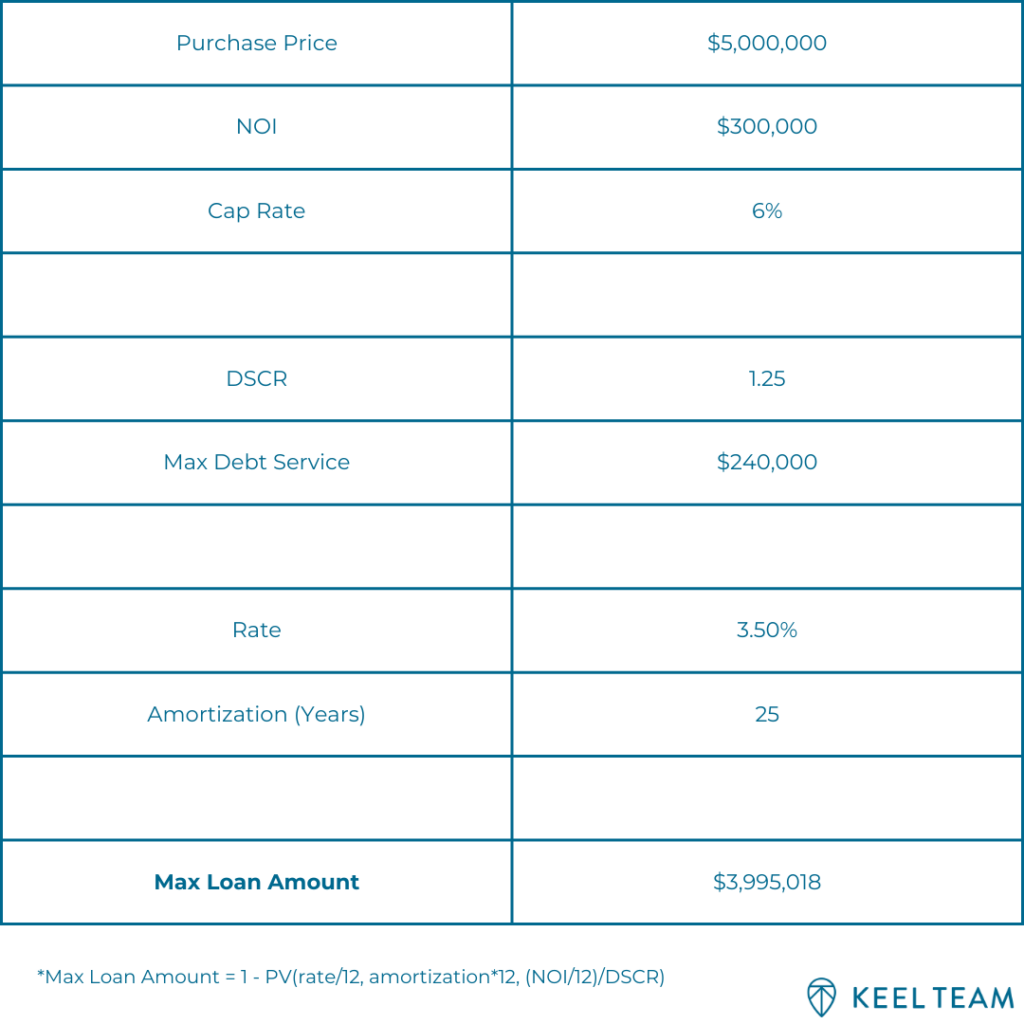
The subject property is a mobile home park with a $5,000,000 purchase price and an NOI of $300,000. This implies a capitalization rate (cap rate) of 6.00% ($300,000 / $5,000,000 = 6.00%).
Assuming a lender insists on a minimum DSCR of 1.25 times, the maximum allowable annual debt service would be $240,000 ($300,000 / 1.25x = $240,000). Lenders would then use their current interest rate and amortization to calculate the maximum loan amount.
Now, let’s rewind the clock 6-12 months ago when interest rates were substantially lower. Assuming an interest rate of 3.50% and a 25-year amortization period, with an annual debt service of $240,000- the maximum loan amount would have been $3,995,018,. This is equivalent to roughly 79.90% Loan-to-Value (LTV) based on the $5,000,000 purchase price. For more, see our your path to mobile home park investing.
Below, you’ll find a calculation in which we’ve determined the Max Loan Amount, with the formula for reference.
Two decades of hard-won lessons on deal underwriting, financing, and operations — free.
Download Free →
Decreasing Loan Amount to Maintain DSCR
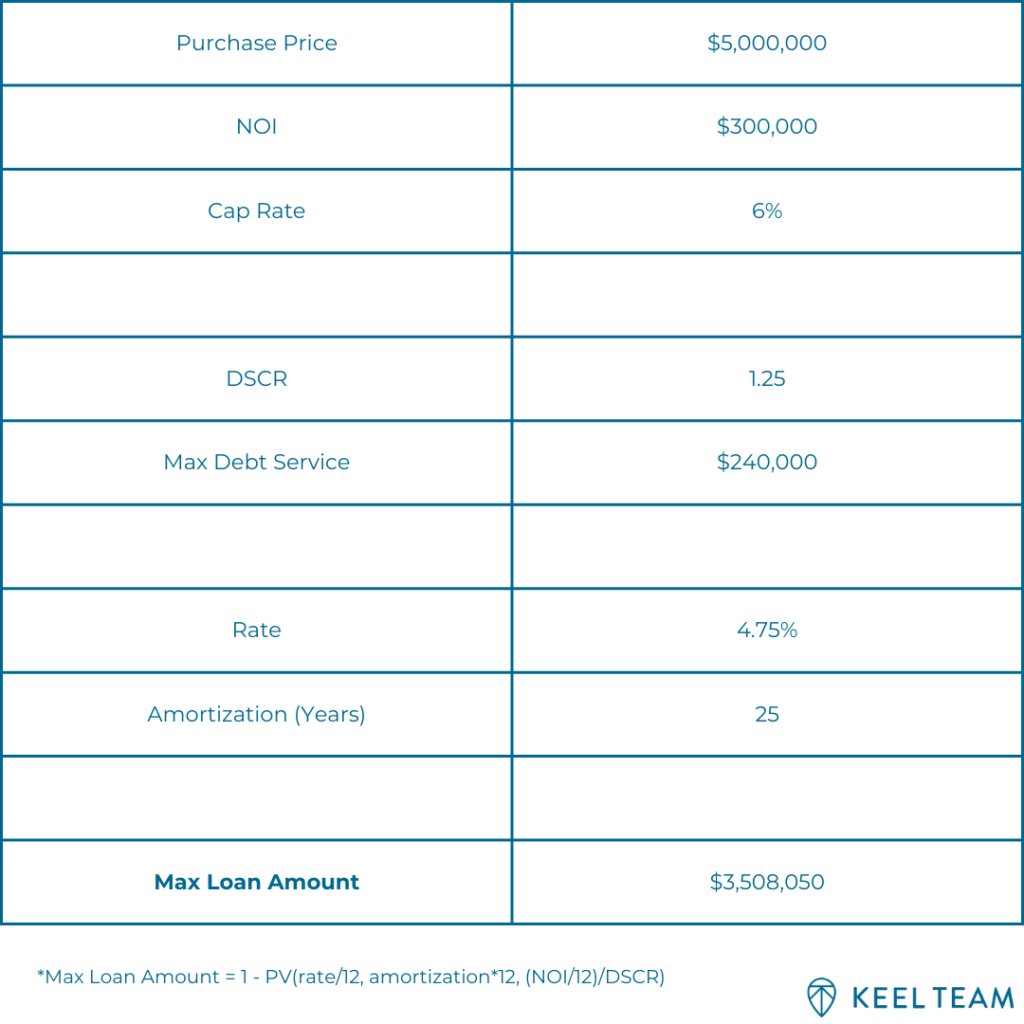
Now, if we assume today’s rates have climbed to 4.75%, while keeping all other variables constant, the annual debt service would surge to $276,413 causing our DSCR to drop from 1.25x to 1.10x, in this example.
In essence, a 1.25% increase in interest rates resulted in an annual debt service hike of $36,413, pushing our DSCR below the 1.25x threshold that most lenders require. To align with this 1.25x DSCR at the higher interest rate, lenders would need to reduce the loan amount so that the debt service drops to a level where the DSCR can once again meet the 1.25x requirement.
If we adhere to the 4.75% interest rate and keep all other factors unchanged but lower the loan amount to achieve a lower annual debt service, the maximum loan amount for the mobile home park acquisition would be $3,508,050. This allows us to maintain the $240,000 annual debt service and meet our 1.25x DSCR. This revised loan amount translates to approximately 70.16% LTV.
Where DSCR Stands in 2026
As of mid-2026, the 10-year US Treasury has stabilized in the 4.25–4.75% range, and mobile home park acquisition financing from community banks and agency lenders (Fannie Mae, Freddie Mac) is pricing in the 6.25–7.25% range depending on deal quality and leverage. That’s a dramatically different world than the 3.50% reference rate used in the original examples above.The practical impact: for the same $5,000,000 mobile home park with $300,000 NOI (6.00% cap rate), a buyer financing at 6.75% over 25 years can only support a loan of approximately $2,750,000 to maintain a 1.25x DSCR — roughly 55% LTV, compared to the ~80% LTV achievable in 2021. This has pushed two major shifts in the market: a persistent bid-ask gap between sellers anchored to 2021 valuations and buyers constrained by current debt costs, and increased focus on deals with stronger in-place NOI (higher lot rents, lower vacancy, city utilities). For a deeper dive on current deal structures, see our guide to mobile home park loan options in 2026.
Bottom line for 2026: Operators who modeled deals assuming a quick return to 4% rates are reassessing. Disciplined underwriting at 6.5–7% debt cost, with a true 1.25x DSCR buffer, is the minimum viable standard for any acquisition that needs to survive a refinance cycle. To see how this affects valuation, check out our step-by-step guide on how to value a mobile home park.
Wrapping Up!
In summary, by increasing the interest rate while keeping all other factors constant, the 1.25% interest rate hike (4.75% vs. 3.50%) necessitates a decrease in loan proceeds of $487,018 ($3,995,018 vs. $3,508,050) for your mobile home park investment, which accounts for nearly 10% of the total purchase price of your mobile home park.
When determining loan sizes for mobile home park investments, lenders often grapple with predicting interest rates 45-60 days into the future when the deal is set to close. Consequently, it’s not surprising if lenders are on the side of caution, leaning toward the higher end of the rate spectrum in anticipation of further interest rate increases.
As with any investment, it’s important to consult with financial and legal professionals to potentially make informed investment decisions and possibly reap the benefits of the mobile home park asset class. Stay tuned for more mobile home park investing guidelines from this blog! For more, see our learn the fundamentals of mobile home park investing.
Are you interested in learning more about passive mobile home park investing? Reach out to us today to explore this niche asset class and potentially reap the benefits of this historical buffer against inflation and rising costs. For more, see our the case for mobile home park investments.
Frequently Asked Questions
What is DSCR in mobile home park investing?
DSCR stands for Debt Service Coverage Ratio. It measures how well a property’s net operating income (NOI) covers its annual debt payments. Most lenders require a minimum 1.25x DSCR for mobile home park acquisitions, meaning the NOI must be at least 25% greater than the annual debt service.
How do rising interest rates affect mobile home park DSCR?
When interest rates rise, annual debt service increases on a given loan amount — which lowers the DSCR. To keep the DSCR at 1.25x, lenders reduce the loan size. Buyers must either bring more equity to close at the same purchase price, or negotiate lower prices to keep the deal financeable.
What DSCR do mobile home park lenders require in 2026?
Most conventional and agency lenders still require a minimum 1.25x DSCR. Some community banks will go to 1.20x on stronger deals. Given current financing rates of 6.25–7.25%, maintaining 1.25x requires substantially more equity than deals closed in 2020–2022.
What cap rate do I need for a mobile home park to pencil with today’s rates?
At 6.75% debt cost and 70–75% LTV with a required 1.25x DSCR, you generally need a going-in cap rate of 6.5% or higher for deals to pencil with reasonable equity returns. Many experienced mobile home park operators are targeting 7–8% caps in 2026 to build in adequate margin against future rate risk.
How has mobile home park financing changed from 2023 to 2026?
In 2023, rates were rising sharply and lenders were cautious. By 2026, rates have stabilized at a higher plateau (agency debt pricing around 6.25–7.25%). The bid-ask gap that opened between buyers and sellers in 2022 has narrowed as sellers have adjusted expectations, but DSCR-constrained underwriting remains the defining feature of the current market.
Includes a full section on mobile home park financing, deal underwriting, and what to look for before you close.
Download the Free eBook →
Disclaimer:
The information provided is for informational purposes only and should not be considered investment advice, nor a guarantee of any kind. There are no guarantees of profitability, and all investment decisions should be made based on individual research and consultation with registered financial and legal professionals. We are not registered financial or legal professionals and do not provide personalized investment recommendations.