If you’re an accredited investor researching passive real estate, you’ve likely encountered two main paths: private syndications and online crowdfunding platforms. Both promise hands-off returns, but they operate very differently — especially when it comes to fees, returns, transparency, and your ability to understand exactly what’s happening with your capital.
This guide breaks down how mobile home park syndications compare to real estate crowdfunding platforms so you can make an informed decision about which structure fits your investment goals.
What Is Real Estate Crowdfunding?
Real estate crowdfunding platforms — companies like Fundrise, CrowdStreet, and RealtyMogul — allow individual investors to pool capital into real estate deals through an online marketplace. Most platforms offer a mix of equity and debt deals across various property types: apartments, office, retail, industrial, and occasionally manufactured housing.
Crowdfunding platforms lowered the barrier to entry significantly. Some accept investments as low as $500, and they’ve opened private real estate to investors who previously couldn’t access it. That’s genuinely useful — but the accessibility comes with trade-offs that experienced passive investors often discover only after committing capital.
What Is a Private Mobile Home Park Syndication?
A mobile home park syndication is a private investment structure where a general partner (GP) — an experienced operator — sources, acquires, and manages a specific mobile home park on behalf of limited partner (LP) investors who provide equity capital.
Syndications are governed by SEC Regulation D, typically under Rule 506(b) or 506(c), and are generally limited to accredited investors. Unlike crowdfunding platforms, you’re investing directly into a specific asset you can visit, evaluate, and track throughout the hold period.
The GP takes responsibility for operations, lender relationships, investor reporting, and ultimately the exit. LPs receive periodic distributions and a share of the profits at sale.
Key Differences: Syndication vs. Crowdfunding Platforms
Minimum Investment
Crowdfunding platforms typically accept $500 to $25,000 minimums depending on the deal and platform. Private mobile home park syndications usually require a minimum of $50,000 to $100,000 per deal. The higher minimum reflects the private nature of the offering and the closer GP-LP relationship that comes with it.
Investor Qualifications
Most private syndications require accredited investor status — a net worth of $1 million or annual income above $200,000 (or $300,000 combined with a spouse). Some crowdfunding platforms accept non-accredited investors, which is why they’re subject to different regulatory requirements and often offer more limited deal access.
Fees and Cost Structure
Crowdfunding platforms layer fees at the platform level on top of deal-level fees: management fees, origination fees, performance fees, and sometimes redemption fees. In a private mobile home park syndication, you deal directly with the GP — typically an acquisition fee (1–3%), an asset management fee (1–2% of revenues), and a carried interest split (often 70/30 or 80/20 LP/GP after a preferred return).
The direct structure means fewer intermediary layers eating into your returns. Over a 5–7 year hold, even a 1% annual platform fee compounds into a meaningful reduction in net returns.
Returns and Distributions
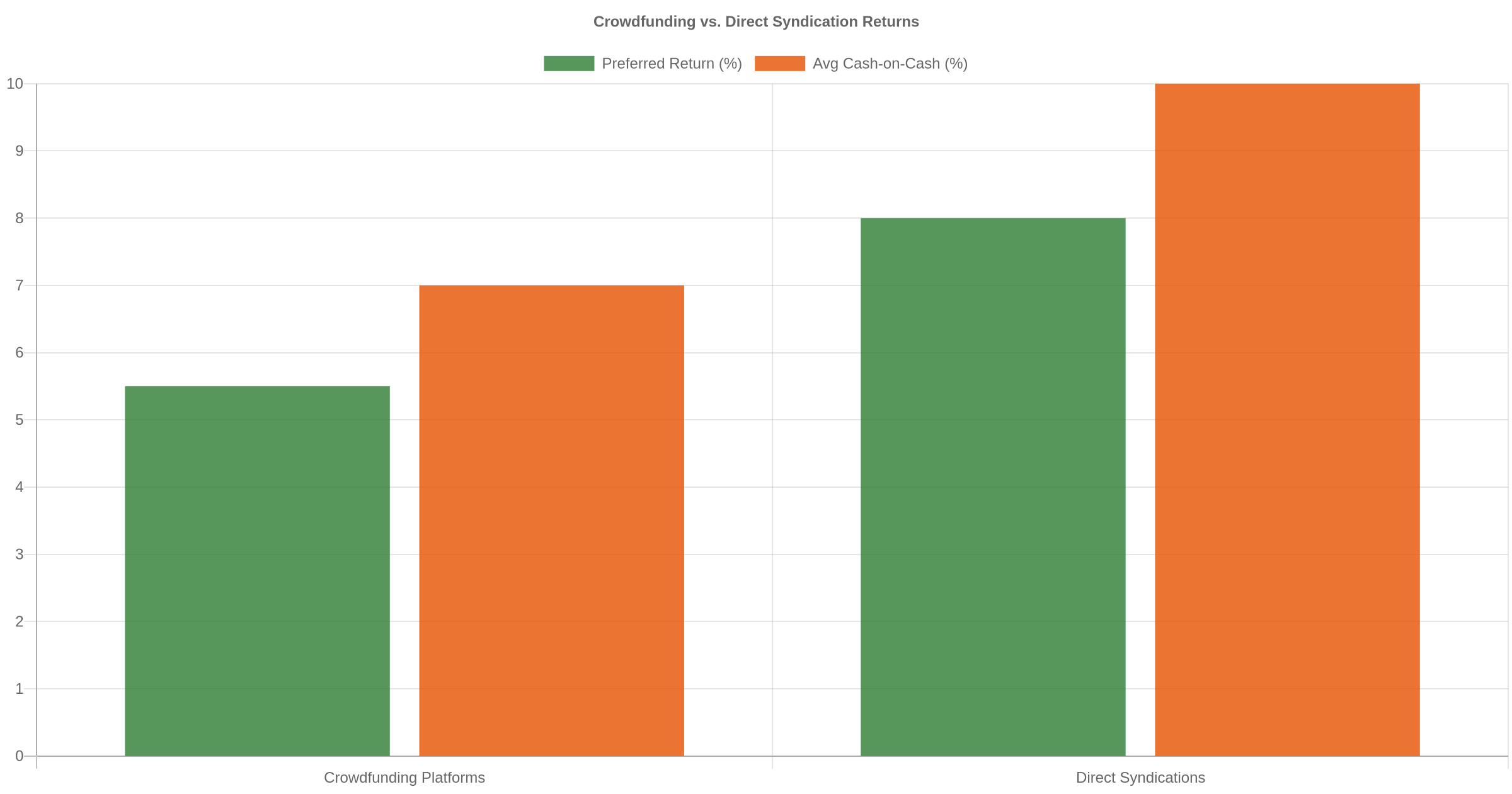
Private mobile home park syndications typically offer a preferred return of 7–9% annually before the GP participates in profits, with total cash-on-cash returns in the 8–12% range during the hold period, plus equity upside at exit. Equity multiples of 1.5x–2.0x over a 5–7 year hold are common in well-executed deals.
Crowdfunding platforms typically report blended portfolio returns — often 5–9% annualized for equity deals — but these figures can be skewed by platform-level deal selection, and past performance isn’t always representative of specific deal outcomes.
Transparency and Investor Relations
In a private syndication, you typically receive monthly or quarterly investor updates directly from the GP — including financials, occupancy data, capital expenditure updates, and operational highlights. You can ask questions directly. You know exactly which asset your money is in.
On crowdfunding platforms, reporting quality varies widely. Some offer detailed deal-level reporting; others provide only summary portfolio metrics. Your relationship is with the platform, not the operator — which adds a layer of separation between you and the underlying asset.
Liquidity
Neither option offers meaningful liquidity, but some crowdfunding platforms (like Fundrise) offer periodic redemption windows. Private syndications are illiquid for the full hold period — typically 5–7 years — with no early exit provisions in most structures. Investors should be prepared to commit capital for the duration.
Asset Specificity and Control
When you invest in a private mobile home park syndication, you know the park: its location, lot count, occupancy rate, utility infrastructure, and the GP’s specific value-add plan. You can evaluate the due diligence materials and make an informed go/no-go decision on that specific asset.
On most crowdfunding platforms — especially those offering diversified funds — your capital is allocated across many deals, providing diversification but reducing your ability to independently underwrite each asset.
Two decades of hard-won lessons distilled into one free guide. Whether you’re evaluating your first deal or your fiftieth, these insights will sharpen your approach.
Why Direct Syndications Often Outperform Crowdfunding Platforms
The math on fees matters more than most passive investors realize. A 1% annual platform fee compounded over a 7-year hold period can reduce your net return by 7–10% in absolute terms — especially when stacked on top of deal-level fees.
Beyond fees, the GP-LP alignment in a well-structured syndication creates strong operator incentive to maximize performance. The GP typically doesn’t receive the bulk of their compensation until investors hit their preferred return threshold, meaning the operator’s profit is directly tied to your returns.
Mobile home park syndications also benefit from asset class characteristics that translate exceptionally well to the structure: low tenant turnover, predictable lot rent income streams, and a fragmented seller market full of value-add opportunities. For a deeper look at what returns to expect from passive mobile home park investments, the data supports why experienced passive investors gravitate toward direct deals in this asset class.
The Case for Real Estate Crowdfunding
Crowdfunding platforms aren’t without merit. For investors who are newer to private real estate, who don’t yet meet accredited investor thresholds, or who want diversification across many deals with smaller check sizes, crowdfunding platforms provide real value.
They’re also simpler operationally — no subscription agreements to negotiate, no individual K-1s from each deal in many structures, and no need to build relationships with individual operators. For investors who want passive income with minimal engagement, platforms can serve that need well.
Who Should Consider Each Option?
A direct mobile home park syndication is typically a better fit if you:
- Are an accredited investor with $50,000+ to commit to a single deal
- Want asset-specific transparency and direct access to the operator
- Are comfortable with a 5–7 year illiquid hold
- Want the full benefit of tax advantages — bonus depreciation, cost segregation, K-1 pass-throughs
- Are building a concentrated, high-conviction private real estate portfolio
A crowdfunding platform may be a better fit if you:
- Are not yet an accredited investor
- Want to invest smaller amounts across many deals
- Prefer a fully hands-off experience with a single platform relationship
- Are newer to private real estate and want lower minimum exposure to learn the asset class
Bottom Line
Crowdfunding platforms democratized access to private real estate, and that’s a meaningful contribution to the investing landscape. But for accredited investors with capital to deploy, a direct relationship with a proven mobile home park operator through a private syndication typically offers better alignment, better transparency, better tax efficiency, and better return potential.
The key is doing your homework: evaluating the operator’s track record, reviewing the deal structure, understanding the specific asset, and asking the right questions before committing. That due diligence is what separates successful passive investors from those who invest and hope for the best.
10 video modules, a 55-page master checklist, and 9 ready-to-use templates that walk you through every step of evaluating a mobile home park deal — from the first site visit to closing day.
Get the top 20 lessons from two decades of mobile home park investing — free.