Most retirees — and those approaching retirement — face a common problem: traditional income sources aren’t keeping up with inflation, expenses, or longevity risk. Savings accounts, bonds, and dividend stocks help, but the yields are modest and the purchasing power erodes over time. That’s why more people in their 50s, 60s, and beyond are looking seriously at mobile home park investing as a source of durable, passive income.
This isn’t a niche strategy for real estate insiders. It’s a straightforward approach to owning a share of an essential housing asset class — one that has historically delivered strong returns with relatively low volatility. Here’s what retirees and pre-retirees should know.
Why Traditional Retirement Income Falls Short
The standard retirement income playbook — Social Security, a 401(k) or IRA, and maybe a bond portfolio — was designed for a different era. Life expectancy has extended significantly. A 65-year-old today may spend 25 to 30 years in retirement. That’s a long runway, and inflation compounds quickly over that kind of timeframe.
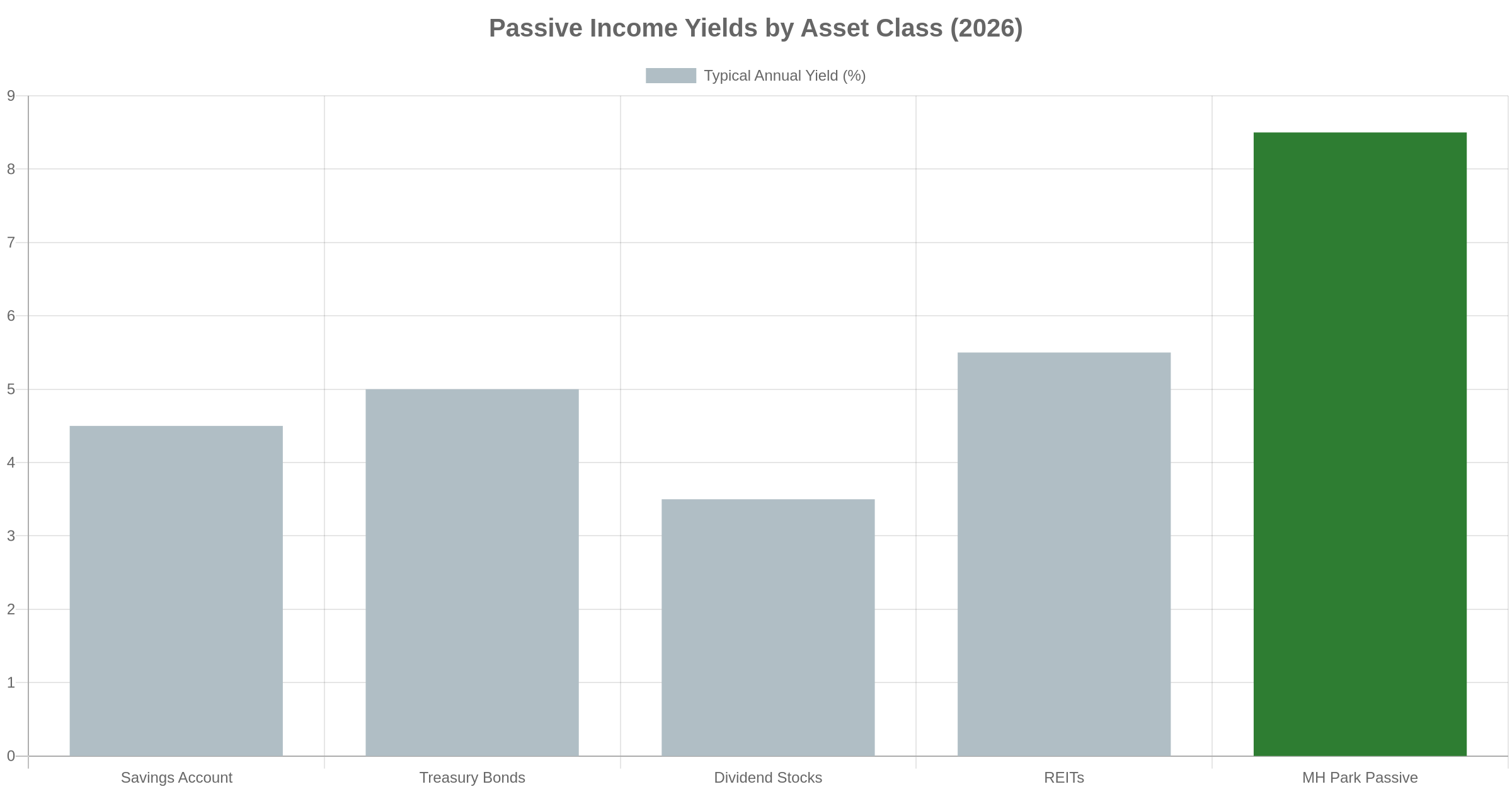
Savings accounts currently yield around 4–5%. Treasury bonds are in a similar range. Dividend stocks average 3–4%. REITs can push 5–6%, but come with stock market correlation and volatility. None of these, on their own, provide the combination of yield, inflation protection, and capital preservation that most retirees actually need.
That’s the gap that real assets — specifically, income-producing real estate like mobile home parks — can help fill.
What Makes Mobile Home Parks Attractive for Retirees
Mobile home parks have a few characteristics that make them particularly well-suited for retirement-stage investors:
Steady, Recurring Income
Mobile home park revenue is almost entirely lot rent — the monthly fee residents pay for the land their home sits on. Because residents own their homes (in most parks), they don’t move often. The average annual turnover rate in a well-run mobile home park is around 2–5%, compared to 40–60% in apartment communities. That stability translates directly to predictable, recurring cash flow for investors.
Inflation Protection Built In
Lot rents can be raised annually, and historically they’ve tracked at or above inflation. Unlike a bond with a fixed coupon, mobile home park income tends to grow over time. For a retiree who is worried about their purchasing power eroding over a 25-year horizon, that built-in inflation hedge matters.
Affordable Housing Demand Is Structural
Manufactured housing is the largest source of unsubsidized affordable housing in the United States. Demand is not cyclical — people need affordable places to live regardless of economic conditions. This makes mobile home parks relatively recession-resistant compared to other real estate asset classes that depend on consumer confidence or discretionary spending.
Limited Supply of New Communities
New mobile home parks are rarely built. Zoning restrictions, community opposition, and regulatory barriers mean the existing supply is largely fixed. That supply constraint supports occupancy rates and lot rent growth for existing parks, benefiting investors who own them.
How Passive Mobile Home Park Investing Works
Most retirees who invest in mobile home parks do so as limited partners (LPs) in a syndication — not as direct owners who manage properties themselves. This is an important distinction.
In a typical mobile home park passive investment, a general partner (GP) or operator identifies, acquires, and manages the community. Limited partners contribute capital and receive a proportionate share of the income and appreciation. They are entirely passive — no tenants, no maintenance calls, no property management responsibilities.
Most mobile home park syndications are structured as private placements under Reg D, typically 506(b) or 506(c). They are generally available to accredited investors — those meeting certain income or net worth thresholds.
As an LP, you typically receive:
- Quarterly or monthly cash distributions (the “preferred return”)
- A share of appreciation at sale or refinance
- Tax benefits including depreciation pass-throughs (which can offset passive income)
The hold period for most mobile home park syndications is 3–7 years, though this varies. Learn more about active vs. passive mobile home park investing to understand which path fits your situation.
Two decades of hard-won lessons distilled into one free guide. Whether you’re evaluating your first deal or your fiftieth, these insights will sharpen your approach.
What Returns Can Retirees Realistically Expect?
Returns vary significantly depending on the operator, the market, and the specific deal structure. That said, well-run mobile home park passive investments have historically targeted:
- Preferred returns: 6–8% annually, paid as regular distributions
- Total returns (including appreciation): 12–18%+ IRR over the hold period
- Equity multiple: 1.5x–2.5x over a 5–7 year hold
These figures are not guaranteed, and performance depends heavily on execution. But even at the conservative end, the income yield from a mobile home park syndication compares favorably to most traditional retirement income vehicles. For a detailed breakdown, see our post on what returns to expect from passive mobile home park investments.
Tax Advantages That Matter in Retirement
One underappreciated benefit of passive mobile home park investing for retirees is the tax treatment. Unlike dividend income or bond interest — which is taxed as ordinary income — mobile home park syndications often generate significant depreciation. That depreciation flows through to LPs as a paper loss, which can offset passive income and reduce your tax bill.
Some operators use cost segregation studies to accelerate depreciation, generating even larger deductions in the early years of ownership. Combined with the preferential tax treatment of capital gains at exit, a mobile home park investment can be significantly more tax-efficient than a bond portfolio or dividend stock account generating equivalent income.
Retirees with large traditional IRA or 401(k) balances may also be able to use a self-directed IRA to invest, which can provide additional tax-deferred (or tax-free, in the case of a Roth) compounding.
Key Considerations Before Investing
Passive mobile home park investing is not right for everyone. Here are a few things to evaluate before committing capital:
Liquidity
Mobile home park syndications are illiquid. Your capital will be locked up for the duration of the hold period (typically 3–7 years). Retirees should only invest capital they don’t need for living expenses or emergencies. This isn’t a replacement for a liquid cash reserve.
Minimum Investment
Most mobile home park syndications have minimum investments of $50,000–$100,000 or more. The strategy is generally best suited to investors who have accumulated significant assets and can diversify across multiple deals or operators.
Operator Quality
The quality of the GP matters enormously. An experienced operator who has navigated full economic cycles is very different from one who has only operated in a rising market. Evaluate track record, transparency, and alignment of interests before committing.
Accredited Investor Status
Most mobile home park syndications require accredited investor status. If you’re unsure whether you qualify, consult a financial advisor or attorney familiar with private placements.
Is Mobile Home Park Investing Right for Your Retirement Portfolio?
For retirees with sufficient liquid assets and a portion of capital they can set aside for a 3–7 year hold, mobile home park passive investing deserves serious consideration. The combination of recurring income, inflation protection, tax efficiency, and relatively low volatility makes it a compelling complement to a traditional retirement portfolio.
It’s not a replacement for diversification or financial planning — but for the right investor, it can be a meaningful and durable source of passive income well into retirement.
If you’re interested in learning more about mobile home park investing and whether it might fit your financial picture, we’re happy to have an educational conversation. Reach out here and we’ll set up a call.
10 video modules, a 55-page master checklist, and 9 ready-to-use templates that walk you through every step of evaluating a mobile home park deal — from the first site visit to closing day.
Get the top 20 lessons from two decades of mobile home park investing — free.