How to Finance a Mobile Home Park: Loan Options Explained
Andrew Keel
[wpbread]
One of the most common questions new investors ask when evaluating mobile home park deals is: how do you actually finance a mobile home park? Unlike single-family rentals or small multifamily properties, mobile home parks sit in a unique asset class — and lenders treat them accordingly. The financing options are different, the underwriting criteria are different, and the path to approval requires a bit more preparation than a standard residential loan.
The good news: capital is available, and for the right deal in the right market, you have more loan options than you might think. Here’s a breakdown of the most common ways to finance a mobile home park acquisition.
Why Mobile Home Park Financing Is Different
Before diving into the loan types, it helps to understand why lenders approach mobile home parks differently than apartments or commercial retail. The key factors are:
Mixed asset classification: Mobile home parks are typically classified as commercial real estate, but the income comes from land rent rather than building rent — which changes how lenders underwrite cash flow.
Utility infrastructure matters: Parks on city water and city sewer are significantly easier to finance than those on private wells or septic systems. Lenders price in operational risk from private utilities.
Tenant-owned vs. park-owned homes: A park where residents own their homes and rent the land is viewed more favorably than one with a large inventory of park-owned homes (which carry additional maintenance and turnover risk).
Occupancy and lot rent: Lenders want to see stabilized occupancy (typically 80%+) and lot rents at or below market rates with room to grow.
Understanding these variables before you approach a lender will save you time and improve your chances of getting to the closing table. If you haven’t done a full mobile home park underwriting analysis yet, that’s the place to start.
Loan Option #1: Conventional Commercial Loans (Local and Regional Banks)
For many mobile home park purchases — especially smaller communities under $3 million — a local or regional bank is often the most practical financing source. These lenders typically offer:
Loan-to-value (LTV): 65–75%
Amortization: 20–25 years, often with a 5- or 10-year balloon
Rates: Variable, typically tied to Prime or a treasury index
Down payment: 25–35%
The advantage of local banks is relationship-based underwriting. They’ll often look at the deal holistically rather than running it through a rigid credit box. The downside is that terms vary widely, prepayment penalties can be punishing, and many local banks have limited experience with mobile home parks specifically.
Best for: Smaller parks, first-time buyers building a track record, deals in rural markets where institutional lenders pass.
Loan Option #2: Agency Debt (Fannie Mae and Freddie Mac)
Both Fannie Mae and Freddie Mac have dedicated mobile home park loan programs, and they’re among the most attractive financing options available for stabilized, income-producing communities.
Loan-to-value: Up to 80% for Freddie Mac, typically 65–75% for Fannie Mae
Amortization: 25–30 years, fully amortizing
Rates: Fixed-rate options available, typically competitive with multifamily agency debt
Minimum loan size: Generally $1–5 million depending on the program
Occupancy requirements: Typically 85–90%+ occupied lots
Agency debt is ideal for stabilized parks with strong occupancy, city utilities, and tenant-owned homes. These loans come with non-recourse provisions, long fixed-rate terms, and can significantly reduce your cost of capital versus local bank financing.
Best for: Stabilized parks with 80+ lots, strong occupancy, city water/sewer, tenant-owned homes.
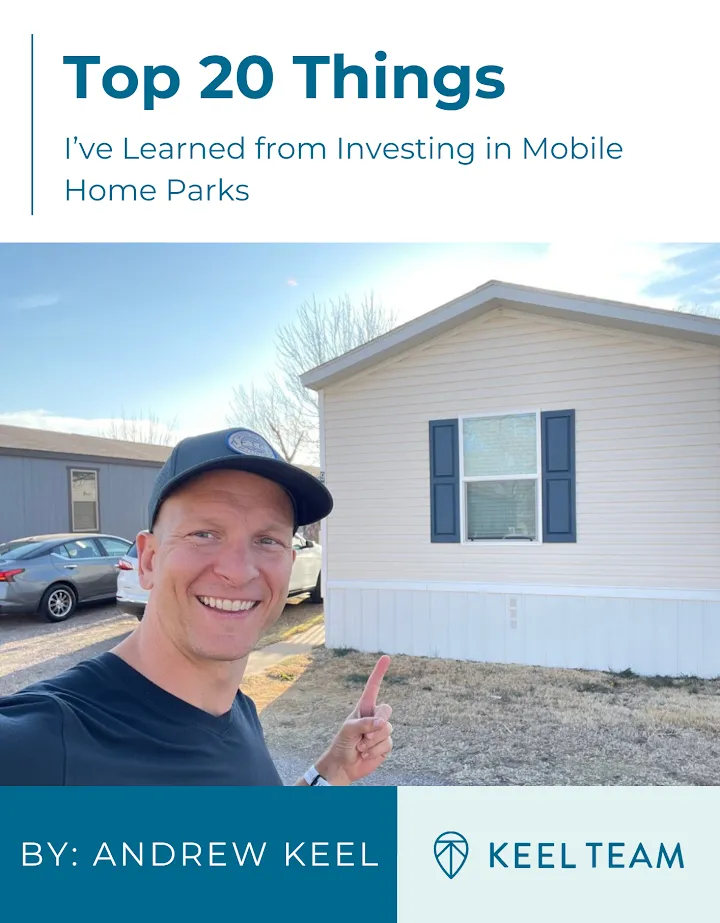
📘 Free eBook: Top 20 Things I’ve Learned from Investing in Mobile Home Parks
If you’re serious about mobile home park investing, this free eBook covers the hard-won lessons from years of acquiring and operating communities across the Southeast and Midwest. Download it free here →
Loan Option #3: SBA 7(a) and SBA 504 Loans
The Small Business Administration offers two loan programs that can work for mobile home park acquisitions, particularly for owner-operators who plan to be actively involved in running the community.
SBA 7(a): The most flexible SBA loan program. Can be used for acquisition, working capital, and improvements. Offers up to $5 million with longer amortization periods and lower down payment requirements (as low as 10–15%).
SBA 504: Designed for fixed assets (real estate and equipment). Works well for mobile home park acquisitions because it splits the loan between a bank (50%), the SBA (40%), and borrower equity (10%). Offers long-term fixed rates on the SBA portion.
The catch with SBA loans: they come with strict owner-occupancy or owner-operation requirements, detailed documentation, and the SBA loan process can be slow. But for buyers who qualify, the lower equity requirements can be a game-changer.
Best for: Owner-operators, first-time buyers with limited capital, smaller acquisitions where conventional lenders are hesitant.
Loan Option #4: Seller Financing
Seller financing is more common in mobile home park acquisitions than in most other commercial real estate asset classes — and that’s one of the reasons off-market deals can be so attractive. Many mom-and-pop operators who have owned their parks for decades prefer the steady income stream of carrying a note rather than a taxable lump-sum cash out.
Typical seller financing terms:
LTV: Varies widely — often 50–80% of purchase price
Interest rates: Usually slightly below bank rates (seller is competing on convenience)
Term: Often 5–10 years with a balloon payment
Amortization: Negotiable — sometimes interest-only in early years
The flexibility of seller financing makes it especially powerful for value-add deals where the park isn’t yet stabilized enough to qualify for institutional debt. You can close on seller financing, stabilize the asset, and then refinance into agency debt once occupancy and financials are in order.
Best for: Off-market deals, value-add acquisitions, parks that don’t yet qualify for institutional debt.
Loan Option #5: Bridge Loans and Private Lending
For turnaround situations — parks with low occupancy, deferred maintenance, or operational issues — conventional and agency lenders will often pass. Bridge loans and private lenders fill this gap.
LTV: Typically 60–70% of current value, sometimes based on ARV (after-repair value)
Rates: Higher — often 8–12%+ depending on risk profile
Term: Short, 12–36 months
Speed: Can close in 2–4 weeks vs. 60–90 days for conventional
Bridge financing is expensive, but it’s a tool — not a long-term solution. The strategy: use a bridge loan to acquire and stabilize the park, then refinance into permanent agency debt once the asset qualifies. You’re essentially buying time to execute your business plan.
Best for: Turnaround plays, distressed acquisitions, time-sensitive deals where conventional lending won’t move fast enough.
What Lenders Want to See
Regardless of which loan type you pursue, lenders across the board will underwrite based on similar criteria. Before approaching a lender, have the following ready:
Trailing 12 months of financials (profit and loss, rent rolls)
Current rent roll with lot numbers, lot rent, and home ownership status
Financing a mobile home park is more nuanced than financing a single-family property — but the options are robust for buyers who come prepared. The right loan depends on the size and condition of the park, your track record, your capital position, and your business plan. Many successful investors layer multiple sources: seller financing to close, private capital for improvements, then a refinance into agency debt once the park is stabilized.
The key is doing your homework before you approach lenders. Know your numbers, know your deal, and know what type of loan your park actually qualifies for — before you’re trying to close under pressure.
Our free guide — Top 20 Things I’ve Learned from Investing in Mobile Home Parks — covers financing strategies, due diligence pitfalls, operations, and more. Grab your free copy →
Andrew Keel
Andrew is a passionate commercial real estate investor, husband, father and fitness fanatic. His specialty is in acquiring and operating manufactured housing communities. Visit AndrewKeel.com for more details on Andrew's story.