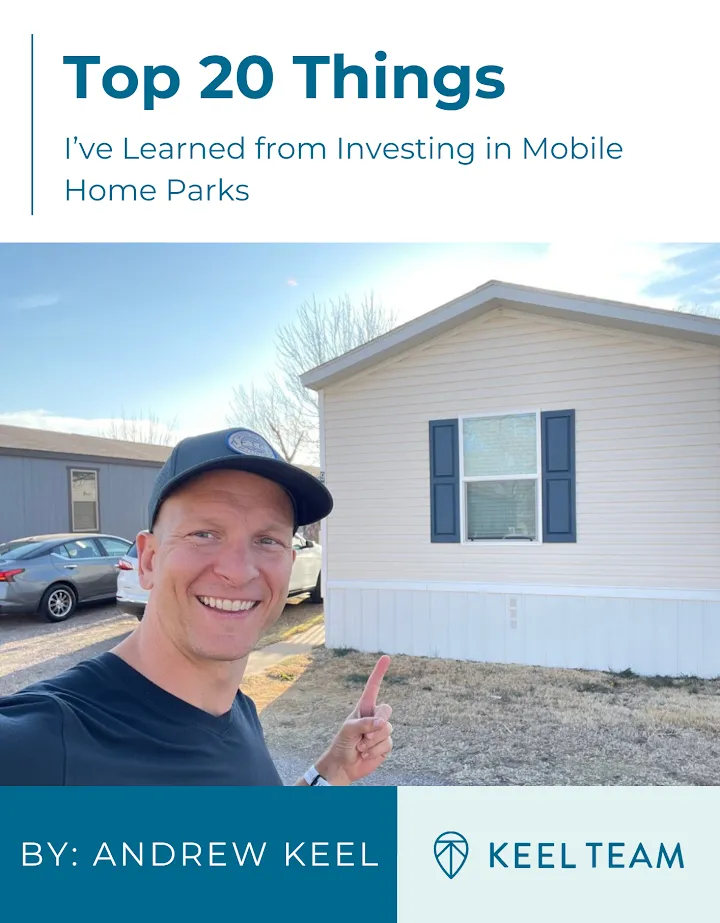
The $60,000 Lesson Every Mobile Home Park Investor Needs to Learn Before They Buy
Andrew Keel
[wpbread]
By Andrew Keel | Keel Team Mobile Home Park Investments
I want to tell you about a mistake I made early in my mobile home park investing career. Not because it’s fun to talk about, but because I see new investors making the same mistake constantly — and in today’s market, with acquisition prices where they are, you cannot afford to find out the hard way.
I purchased a mobile home park that looked solid on paper. Occupancy was reasonable, lot rents were below market, and the path to value-add was clear: infill vacant lots with new homes and increase revenue. Simple enough thesis.
Then I started bringing in new homes.
The electrical infrastructure couldn’t handle it.
The pedestals were outdated. The service entrance was undersized. The electrical system that had been “fine” for decades of existing residents couldn’t support modern manufactured homes’ electrical loads. Before I could finish the infill plan I’d underwritten, I was writing a $60,000 check for electrical upgrades I hadn’t budgeted for.
That was an expensive education. But it was also one of the most clarifying experiences of my investing career, because it forced me to completely rethink how I do due diligence on utilities and infrastructure.
Why Mobile Home Park Infrastructure Is Different
Mobile home parks are unique real estate assets in a lot of ways, but nowhere more so than underground and overhead infrastructure.
Most mobile home parks were built between the 1940s and 1970s. That means water mains, sewer lines, and electrical systems designed 50 to 80 years ago for homes that drew a fraction of the power and water that modern manufactured homes require.
The materials used then — Orangeburg pipe for sewer, galvanized steel for water, pre-load-calculation electrical service entries — have largely exceeded their design lifespans. They work until they don’t. And in a mobile home park, when they stop working, you have a problem that affects every resident simultaneously.
The challenge is that most of this infrastructure is underground or otherwise invisible. A visual walkthrough of a park can look completely normal while $200,000 of deferred maintenance sits six inches below the surface.
What “General” Inspectors Miss
When I talk to investors who’ve gotten burned on infrastructure, the single most common thread is this: they hired a general commercial property inspector who walked the property, checked the visible structures, and gave a thumbs up.
General inspectors are great at what they’re trained for. Mobile home park infrastructure is not what they’re trained for. They don’t know to pressure-test water lines and look for a 30–40% loss rate that indicates widespread underground leaks. They don’t know to camera-inspect sewer mains for Orangeburg degradation or root intrusion. They don’t know to load-test electrical pedestals against modern amperage requirements.
You need an inspector — or ideally a team — who specializes in manufactured housing communities. These people exist. There aren’t many of them, but they know exactly what failure modes to look for in mobile home park-vintage infrastructure.
The Five Infrastructure Questions I Ask on Every Deal
After my $60,000 lesson and years of additional experience, here’s the due diligence checklist I run on every park I consider. (This is also covered in depth in the Keel Team MHP Due Diligence Playbook, which walks through our full acquisition process step by step.)
1. Are utilities public or private? Public utilities (city water, city sewer) dramatically reduce your risk profile. You’re not responsible for the main lines; the city is. Private utilities — on-site well, on-site septic, lagoon systems — require intensive additional scrutiny and carry ongoing operational and regulatory risk. I generally require city water and city sewer as a baseline buying criterion.
2. Have sewer lines been camera-inspected? This is non-negotiable. Camera inspection of sewer mains will run you $500–$2,000 depending on park size. That’s not a cost to cut. A failed sewer line in an older park can require full replacement at $1,000–$3,000 per lot. On a 100-lot park, that’s a $100,000–$300,000 capital event. Camera inspection before closing is the cheapest insurance policy in this business.
3. Does the electrical system support modern loads? Don’t just ask if the lights are on. Get the electrical service entry specifications and compare them to the load requirements of the homes you plan to infill. Have a licensed electrician — one who has worked in manufactured housing communities — assess the pedestals, service panels, and entry equipment.
4. Are water lines pressure-tested? A water pressure test can reveal whether there are significant underground leaks in the distribution system. I’ve seen parks where 30–40% of the water the park was paying for every month was leaking underground, unknown to the owner. That’s both an operational cost issue and a sign of infrastructure nearing failure.
5. Are there any water or sewer repair records? Ask for maintenance logs. If a park has had repeated sewer backups, repeated water main breaks, or a pattern of repair-and-patch work, that’s a sign of systemic infrastructure decay, not isolated incidents. Repair history is one of the most underutilized data points in mobile home park due diligence.
How to Price Infrastructure Risk
Once you have inspection data, you need to turn it into underwriting adjustments.
Here’s the framework I use: Assume that any park built before 1990 needs a baseline $500–$1,500 per lot in infrastructure reserves baked into the model. If inspection comes back clean, great — that’s upside or capital you can deploy on infill. If inspection reveals specific issues, model the full replacement cost at fair market contractor rates (not optimistic estimates) and adjust your offer accordingly.
I’ve walked away from parks where the infrastructure condition made the math impossible. I’ve also closed deals at prices that reflected the real cost of what needed to be done. Both outcomes are better than the third option: closing at full price and discovering the problem after you own it.
The Bottom Line
Infrastructure due diligence is not glamorous. It’s not the part of mobile home park investing that gets featured in “passive income” YouTube videos. But it’s the part that separates investors who build durable portfolios from investors who get schooled by a single expensive surprise.
Spend the $1,500 on a thorough inspection. Hire someone who’s done it before. Pressure-test the water. Camera the sewer. Load-test the electrical. And build the cost of what you find into the price you’re willing to pay.
The parks that look cheap sometimes are cheap for a reason. The ones that look clean sometimes just look clean. The only way to know which you’re dealing with is to check.
I learned that lesson for $60,000. You don’t have to.
Andrew Keel is the CEO of Keel Team Mobile Home Park Investments, a Mooresville, NC-based company that acquires and operates mobile home communities across the Southeast and Midwest.
Andrew Keel
Andrew is a passionate commercial real estate investor, husband, father and fitness fanatic. His specialty is in acquiring and operating manufactured housing communities. Visit AndrewKeel.com for more details on Andrew's story.