Affordable housing remains one of the most pressing needs in the United States. At the same time, investors keep searching for assets that can produce steady cash flow. A value-add mobile home park investment can sit right where those two needs meet. This case study walks through how one 49-lot mobile home park in the Virginia Beach-Norfolk metro area moved from acquisition to a cash-out refinance in about 28 months, and what that may mean for investors exploring the asset class.
Why the Virginia Beach-Norfolk Market Stands Out
The mobile home park sits in the Virginia Beach-Chesapeake-Norfolk metropolitan statistical area (MSA), formerly known as Virginia Beach-Norfolk-Newport News. Locals simply call the region Hampton Roads. The U.S. Census Bureau estimated the metro population at 1,797,213 in 2025, the highest figure on record.
A Deep Military Employment Base
Hampton Roads hosts Naval Station Norfolk, the world’s largest naval base, along with more than 82,000 local military personnel. Military payrolls tend to hold up through economic cycles, which can help support steady housing demand.
Rising Housing Costs
Meanwhile, housing costs keep climbing. The region’s median home price reached about $375,000 in June 2025, up 4.2% year over year. In addition, CoStar ranked Hampton Roads fourth in the nation for multifamily rent growth in August 2025. As a result, more working households may look for lower-cost options such as manufactured housing.
The Acquisition: A 49-Lot Value-Add Mobile Home Park Investment
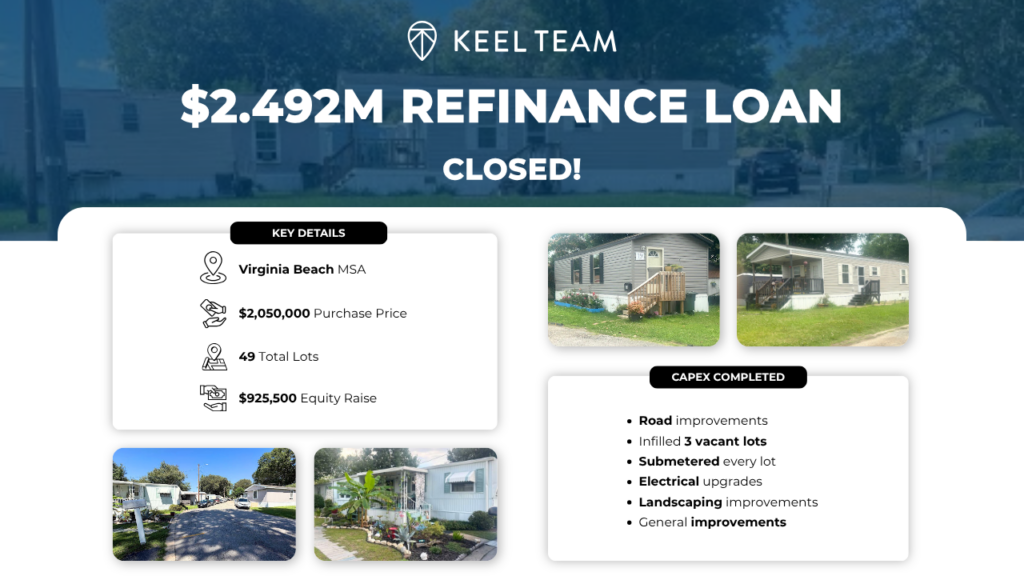
In June 2024, Keel Team and its investment partners purchased the 49-lot mobile home park for $2,050,000, or roughly $41,800 per lot. Partners contributed $925,500 in total equity. Of that, $512,500 covered a 25% down payment, while acquisition financing covered the remaining 75% of the purchase price. The other $413,000 went toward capital improvements and miscellaneous costs.
Importantly, only the general partners signed on the recourse acquisition debt. No limited partner investors carried personal liability on the loan.
Want to learn more about mobile home park investing?
Keel Team publishes educational resources that explain how mobile home park communities operate. If you have questions, you are welcome to reach out and start a conversation.
The Value-Add Business Plan
The team focused on improvements that could raise net operating income (NOI) and make the community more attractive to residents.
Filling Vacant Lots
First, the team worked on infilling vacant pads. It set aside $105,000 to buy and remodel used homes for empty lots. Each newly occupied lot can add lot rent, which may lift NOI.
Upgrading Infrastructure and Curb Appeal
Next, the team budgeted $125,000 for general capital improvements.
Capital Expenditure Breakdown
| Improvement | Budget |
|---|---|
| Electrical Infrastructure Improvements | $30,000 |
| Road Surface: Paving and Improvements | $25,000 |
| Water Submetering | $24,500 |
| Landscaping: Trees and Grounds | $15,000 |
| Street Lights | $10,500 |
| General Appearance Improvements | $10,000 |
| Signage | $5,000 |
| Office to Storage Conversion | $5,000 |
| Total General Improvements | $125,000 |
Water submetering stands out here. When residents pay for the water they use, the owner can recover a cost that might otherwise drag down NOI.
Modest Lot Rent Increases
Finally, the team applied modest lot rent increases. For context, the Manufactured Housing Institute (MHI) reports that the average site rent increase across the country was 6.4% in 2024. Even after an increase, lot rent at a mobile home park often stays well below apartment rent in the same market.
The Results: Capital Returned in 28 Months
Preferred Distributions
Starting in month six, investors received a 10% preferred return, paid quarterly. A standard quarterly payment came to $23,137.50. Across eight distributions, the partnership paid out $219,795.99.
Preferred Distribution Schedule
| Distribution Date | Amount |
|---|---|
| December 2024 | $49,606.80 |
| March 2025 | $23,137.50 |
| June 2025 | $23,137.50 |
| September 2025 | $23,137.50 |
| December 2025 | $23,137.50 |
| March 2026 | $23,137.50 |
| June 2026 | $23,137.50 |
| October 2026 | $31,364.19 |
| Total Preferred Distributions | $219,795.99 |
The Cash-Out Refinance
On October 26, 2026, the team refinanced the mobile home park with a $2,492,000 Fannie Mae agency loan at a 6.72% interest rate. The cash-out refinance returned $925,500 to partners, which equals 100% of their original equity. Based on a $4,000,000 appraisal, the new loan sits at roughly 62% loan-to-value (LTV), compared with 75% at acquisition.
Just as importantly, the new loan is non-recourse. In simple terms, the lender generally looks to the property itself, rather than the borrowers’ personal assets, if the loan defaults. Agency lenders also tend to apply strict underwriting standards, so securing Fannie Mae financing may signal that the property’s operations have stabilized.
Summary of Returns
| Item | Amount |
|---|---|
| Preferred Return Distributions | $219,795.99 |
| Cash-Out Refinance Distribution | $925,500.00 |
| Total Distributions | $1,145,295.99 |
| Initial Equity Investment | ($925,500.00) |
| Total Return on Capital | $219,795.99 (23.75%) |
| Business-Plan Period | 28 months (2.33 years) |
| Annualized Cash-on-Cash ROI | 10.19% |
What Could Come Next
Even with their capital returned, investors keep their ownership stake. That position may open several future opportunities:
- Remaining equity: Based on the refinance appraisal of $4,000,000, roughly $1,508,000 in equity may remain in the property.
- Supplemental loan: A supplemental loan may become available 12 months after the refinance, depending on loan terms.
- Appreciation: The community could continue to grow in value as operations improve.
Because investors no longer have their original capital in the deal, any future cash flow could produce what many investors call “infinite returns.”
Why Mobile Home Park Investing Deserves a Closer Look
This case study highlights several traits that can make the asset class attractive.
Affordability Drives Demand
According to MHI, a new manufactured home costs less than one-third the price of a site-built home. Roughly 16.6 million Americans lived in manufactured homes in 2023. As housing costs rise, that affordability gap may keep demand strong.
Multiple Value-Add Levers
A mobile home park can offer several ways to grow NOI at once. Owners can fill vacant lots, submeter utilities, adjust below-market rents, and upgrade infrastructure.
Limited Investor Liability
In this deal, limited partners never signed on recourse debt. Furthermore, the refinance moved the property onto non-recourse Fannie Mae agency financing.
Final Thoughts
This case study shows how a focused value-add plan may turn an underperforming mobile home park into a stronger, more valuable community. Of course, every deal carries its own risks, and results can vary widely. Still, for investors who want exposure to affordable housing, a value-add mobile home park investment may deserve a place on the shortlist.
Want to learn more about mobile home park investing?
The Keel Team is happy to answer your questions and help you understand how mobile home park communities work. Reach out to continue the conversation — there is no obligation.
Disclaimer:
This article is for educational and informational purposes only. It was written with the help of AI and reviewed by the Keel Team. It is not investment, tax, or legal advice, and it is not an offer to sell or a solicitation of an offer to buy any security. Any such offer is made only through official offering documents to eligible investors. All investments carry risk, including the potential loss of principal. Consult your own advisors before investing.