Passive income has become the Holy Grail for those seeking to diversify their income streams and achieve financial freedom. In a world where economic stability can sometimes seem like a pendulum, having multiple sources of income can be a game-changer. Here’s a look at 27 passive income ideas that can help pave your way to a more potentially secure financial future.

1. Passive Mobile Home Park Investing
Investing with operators that put your money to work is becoming a popular trend that many investors are following. This involves pooling your money with other investors into a syndication or fund, and a sweat equity partner who then executes the business plan and typically secures solid returns for their investors. Mobile home park investing has gained significant traction because of the asset class’s strong fundamentals — affordable housing demand, limited new supply, and recession-resilient cash flows. Typical passive investors in mobile home park syndications target 8–10% preferred returns with potential total returns of 15–20%+ IRR over a 3–7 year hold period. Minimum investments usually start at $50,000–$100,000, and the time commitment for passive investors is minimal after the initial due diligence phase. For a comprehensive overview of this asset class, check out our complete guide to mobile home park investing. You can also learn more about mobile home park syndication explained.
2. Selling Courses:
If you’re knowledgeable in a particular area, creating and selling courses online can provide income long after the initial work is done.
3. High-Yield Savings Accounts (HYSAs):
With typically better interest rates than traditional savings accounts, HYSAs are typically a low-effort way to make your money work harder.
4. Rental Property:
Real estate is a tried and tested avenue for passive income. Renting out property can potentially provide regular income and potential tax benefits.
5. Peer-to-Peer (P2P) Lending:
Through P2P platforms, you can lend money to individuals or businesses and potentially earn interest on the loans.
6. Real Estate Investment Trusts (REITs):
REITs are companies that own income-generating real estate, and you can usually earn dividends from these investments.
7. Bonds:
Buying government or corporate bonds is lending money in exchange for regular interest payments.
8. Amazon FBA:
With Fulfillment by Amazon, you can sell products online and Amazon takes care of storage and shipping.
9. eCommerce:
Setting up an e-commerce store can be lucrative, especially if you can automate most of the operations.
10. ATM Business:
Owning and operating ATMs can generate income through transaction fees.
Download our free eBook on the “Top 10 Things to Review When Considering a Passive Mobile Home Park Investment “
By Andrew Keel
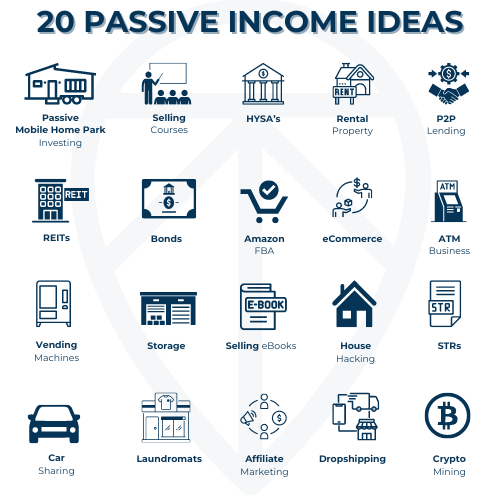
11. Vending Machines:
Similar to ATMs, vending machines can be a source of income through sales in high-traffic areas.
12. Storage Units:
Renting out storage space is a low-maintenance way to potentially earn money.
13. Selling eBooks:
If you’re a writer or knowledgeable in a specific area, self-publishing eBooks can potentially provide a steady stream of income.
14. House Hacking:
Renting out a portion of your primary residence can help cover your mortgage and other expenses.
15. Short-Term Rentals (STRs):
Platforms like Airbnb make it easier than ever to rent out extra space for short periods of time.
16. Car Sharing:
Renting out your vehicle when you’re not using it can help rack up earnings over time.
17. Laundromats:
A staple in passive income lists, laundromats can be profitable with the right location. For more, see our why mobile home park investments outperform. For more, see our passive investing in mobile home parks.
18. Affiliate Marketing:
Earn commissions by promoting other companies’ products or services.
19. Dropshipping:
Sell products without holding inventory, as suppliers ship directly to customers.
20. Crypto Mining:
If you have the technical know-how, mining cryptocurrencies can be a passive way to earn digital currency.
21. Car Wash Businesses:
Automated car washes have become one of the more popular passive income plays in recent years. A fully automated express tunnel car wash can generate $500,000–$1,000,000+ in annual revenue with profit margins of 30–50%. Startup costs are significant — typically $2–$5 million for a new build — but investors can also purchase existing car washes for less. Monthly membership models (typically $20–$40/month per customer) create highly predictable recurring revenue. Once the systems are dialed in and you have a competent manager on-site, the time commitment drops to just a few hours per week of oversight. Self-serve bay washes are a lower-cost entry point at $200,000–$500,000 but generate less revenue.
22. Dividend Stock Portfolios:
Building a portfolio of dividend-paying stocks is one of the most accessible passive income strategies. Blue-chip dividend stocks typically yield 2–5% annually, while higher-yield dividend ETFs and funds can potentially return 4–8%. You can start with as little as a few hundred dollars through fractional share platforms, and the time commitment is minimal — a few hours per quarter to review your holdings. The key is reinvesting dividends early to harness compound growth, then switching to cash payouts when you need the income. A $500,000 portfolio yielding 4% produces $20,000 per year in passive income with virtually zero ongoing effort.
23. Farmland Investing:
Farmland has historically returned 10–12% annually (including both land appreciation and crop income) and has outperformed many traditional asset classes over the past two decades. Platforms like AcreTrader and FarmTogether have made it possible to invest in farmland for as little as $10,000–$25,000 minimum, compared to the hundreds of thousands previously required to buy a farm outright. Investors earn income from crop lease payments (typically 2–5% cash yield) plus long-term land appreciation. Farmland is also a strong inflation hedge since food prices and land values tend to rise with inflation. The time commitment for passive farmland investors is essentially zero — the platform and farm operators handle everything.
24. Billboard and Advertising Land Leases:
If you own land near a highway or high-traffic road, leasing it for billboard advertising can generate $1,000–$5,000+ per month with virtually no effort on your part. Even if you don’t currently own land, you can purchase small parcels in strategic locations for $10,000–$50,000 and lease them to billboard companies like Lamar or Clear Channel. Digital billboards command even higher rents. The beauty of this model is its simplicity — the billboard company handles installation, maintenance, and advertiser relationships. Your only job is to cash the lease checks. Returns on invested capital can reach 15–30%+ annually depending on the location and traffic count.
25. Music and Podcast Royalties:
Creating original music, podcasts, or audio content can generate royalties for years after the initial work is complete. Platforms like Spotify, Apple Music, and YouTube pay per-stream royalties, and a catalog of even modest-performing tracks can compound over time. Alternatively, you can invest in music royalties through platforms like Royalty Exchange or ANote Music, purchasing the rights to existing song catalogs for $1,000–$100,000+. Expected returns typically range from 5–12% annually. On the creation side, startup costs are low — quality recording equipment and software can be had for $500–$2,000 — but the upfront time investment is significant. The payoff is truly passive income that can last decades.
26. License and Patent Royalties:
If you’ve invented a product, process, or piece of software, licensing your intellectual property can generate ongoing royalty income without any additional work. Patent holders typically earn 2–7% royalty rates on net sales of the licensed product, and a single well-placed patent can generate $10,000–$500,000+ per year. You can also purchase existing patents through brokers or auction platforms as an investment. The upfront costs vary widely — filing a patent runs $5,000–$15,000, while purchasing an existing one can range from $10,000 to millions depending on the technology. Time commitment after licensing is minimal, usually limited to occasional audits to ensure licensees are reporting accurately.
27. Digital Product Sales:
Selling digital products like printable planners, design templates, spreadsheet tools, stock photos, or software plugins can create a scalable passive income stream. Platforms like Etsy, Gumroad, and Creative Market handle distribution and payments, so your only job is creating the product upfront. Top sellers on these platforms earn $5,000–$50,000+ per month, though more realistic starting expectations are $500–$2,000 per month within the first year. Startup costs are minimal — often just your time and a $10–$50/month subscription to a design tool like Canva or Figma. Once a digital product is created and listed, it can sell an unlimited number of times with zero marginal cost, making this one of the most scalable passive income models available.
Mastering Wealth with Passive Income
The key to successfully generating passive income typically lies in diversification and consistent effort. Not all streams may be suitable for everyone, and some require more work upfront or ongoing attention. However, even just a few of these can help build a robust financial portfolio, hedge against market fluctuations, and potentially lead to financial independence.
Remember, before diving into any passive income venture, do your research, understand the risks involved, and consider seeking advice from financial professionals. With careful planning and a strategic approach, you can potentially harness these passive income ideas to help build wealth and secure your financial future.
At Keel Team Mobile Home Park Investments, we’re dedicated to enhancing communities while potentially maximizing investor returns. Our focus is on improving residents’ lives while delivering strong profits to our partners. Get in touch using the contact details below to learn more about our investment approach and strategy.
Disclaimer:
The information provided is for informational purposes only and should not be considered investment advice, nor a guarantee of any kind. There are no guarantees of profitability, and all investment decisions should be made based on individual research and consultation with registered financial and legal professionals. We are not registered financial or legal professionals and do not provide personalized investment recommendations.