Mobile Home Park Investing at Scale with Nathan Jameson and Andrew Keel
-
 Andrew Keel
SHOW NOTES
Host: Andrew Keel, Founder of Keel Team Real Estate Investments
Guest: Nathan Jameson, Founder and Managing Partner of Arx Capital
Learn more about mobile home park investing: https://keelteam.com/mobile-home-park-investing/
Episode Summary
In this episode, Andrew Keel welcomes Nathan Jameson, a real estate investor-operator focused on durable-demand assets through Arx Capital. Nathan Jameson shares his disciplined, stewardship-driven approach to building a mobile home park portfolio of nearly 2,000 sites across the Northeast and Mid-Atlantic. The conversation explores why self-management is critical for mobile home park operational success and how a performance-driven leadership style—rooted in Nathan Jameson’s background as a Division I athlete—creates long-term value for both residents and investors.
We zero in on why self-management matters, the hidden costs that trip up new trailer park operators, and how a stewardship-driven approach creates long-term value for residents and investors alike. We also chat about acquisitions, operations, team building, utility management, affordable housing, and the challenges facing the industry over the next several years.
Nathan Jameson is a real estate investor-operator focused on necessity-based, durable demand assets. Through Arx Capital, he invests with a long-term, stewardship-driven mindset across resilient strategies, with a strong focus on mobile home parks and affordable housing.
Before investing, Nathan was a Division I athlete and coach, an experience that shaped his disciplined, performance-driven approach to leadership and execution.
About the Host:
Andrew Keel is the owner of Keel Team, LLC, a Top 50 Owner of Manufactured Housing Communities with over 3,250 lots under management across more than 50 communities in 15+ states.
Andrew Keel specializes in turning around under-managed manufactured housing communities by implementing proven systems to maximize occupancy while reducing operating costs. His expertise includes:
- Bringing in mobile homes to fill vacant lots.
- Implementing utility bill-back programs.
- Improving overall management and operating efficiencies in mobile home parks.
These strategies significantly boost both asset value and net operating income.
- Learn more at keelteam.com.
- Find out more about Andrew’s story at andrewkeel.com.
- Learn how to invest in mobile home parks: https://keelteam.com/mobile-home-park-investing/
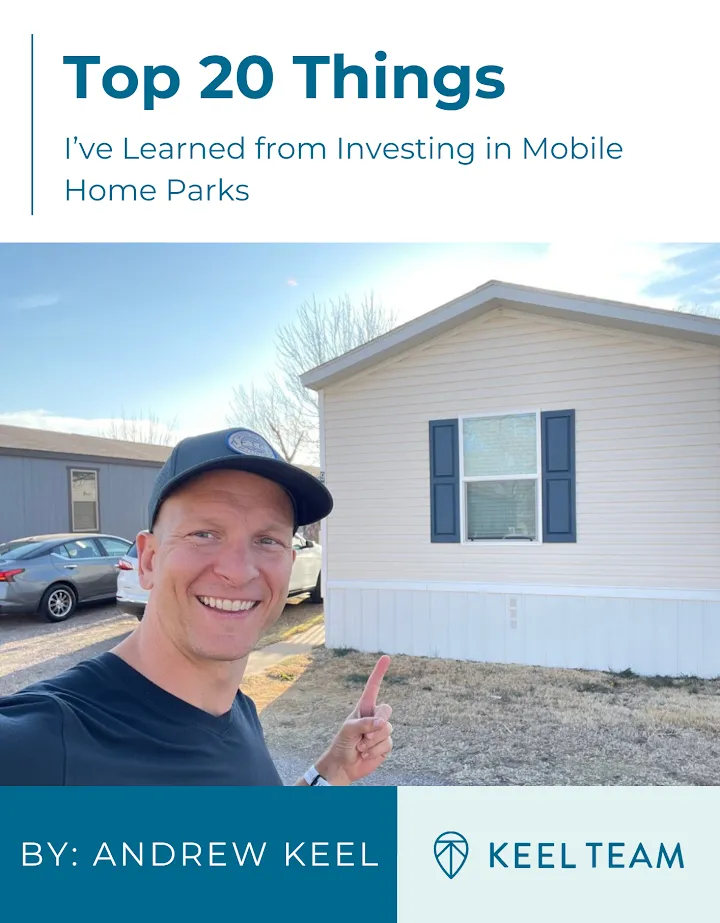
- Check out Andrew’s FREE e-book: “The Top 20 Things You Need to Know Before You Start Investing in MHPs” available here: https://keelteam.com/top-20-things-learned-from-mobile-home-park-investing/.
Support the Show
If you are getting value out of this podcast, please head over to iTunes and leave a quick five-star review to help us hit our goal of over 500 total 5-star reviews.
- Leave a Review on Apple Podcasts (iPhone, iPad, or Mac users): Leave a Review on Apple Podcasts
- Follow Our Projects: See mobile home park projects in progress on Instagram: @passivemhpinvesting.
- Subscribe to the Passive Mobile Home Park Investing Podcast YouTube Channel: https://www.youtube.com/channel/UCy9uI3KGQmFgABsr9lUtRTQ.
Talking Points:
Episode Timestamps & Key Takeaways
00:21 – Welcome to the Passive Mobile Home Park Investing Podcast
01:39 – Nathan Jameson traces his interest in real estate back to witnessing the boom-and-bust cycle of Oklahoma housing during the 1980s.
03:05 – How a career in land acquisition for a homebuilder shaped his investment philosophy and focus on highest-and-best-use analysis.
03:54 – Why Nathan Jameson transitioned from homebuilding to cash-flow-focused investments and ultimately chose mobile home parks.
06:00 – The powerful supply-and-demand dynamics behind manufactured housing and why declining supply continues to support the asset class.
07:00 – An overview of ARX Capital’s mobile home park portfolio, which includes approximately 2,000 sites across multiple funds.
07:30 – Lessons learned from early property management experiences and why ARX now self-manages all of its mobile home park communities.
10:20 – The tax advantages of mobile home park investing and Nathan Jameson’s surprise when his first K-1 showed losses despite positive cash flow.
12:10 – Why are people simultaneously the hardest and most important part of the business?
15:09 – How ARX uses the Entrepreneurial Operating System (EOS) to build accountability, leadership, and organizational clarity.
16:00 – Nathan Jameson’s coaching background and how athletic competition influences his leadership philosophy today.
18:12 – The true cost of filling mobile home park vacant lots and why many operators underestimate home setup expenses.
20:00 – How ARX evaluates communities, from older mobile home parks to higher-end manufactured housing communities.
22:30 – Common areas where operators unknowingly lose money, including water leaks, utility inefficiencies, and weak operational oversight.
25:00 – Why active management—not passive ownership—is essential for success in the mobile home park business.
27:15 – Challenges Nathan Jameson expects operators to face as rising rates, rent regulations, and operational realities expose weak business models.
31:25 – ARX’s evolving acquisition strategy, including selective investments in RV parks and self-storage facilities.
35:00 – How Nathan Jameson sources deals through broker relationships, direct outreach, referrals, and rapid response times.
37:00 – Red flags during due diligence, including rent-roll stuffing, weak collections, and lack of resident pride of ownership.
40:40 – Lessons learned from a disappointing investment and why tax benefits should never drive acquisition decisions.
42:25 – The number one factor Nathan Jameson looks for when passively investing with another operator: meaningful personal capital invested alongside LPs.
44:00 – Nathan Jameson’s rapid-fire opinions on states, operations, resident management, rent control, and the future of the industry.
48:30 – Conclusion
Links & Mentions from This Episode:
Nathan’s Email: nathan@arxventures.com
Arx Capital: https://www.arxventures.com/
Keel Team’s official website: https://www.keelteam.com/
Andrew Keel’s official website: https://www.andrewkeel.com/
Andrew Keel LinkedIn: https://www.linkedin.com/in/andrewkeel
Andrew Keel Facebook page: https://www.facebook.com/PassiveMHPinvestingPodcast
Andrew Keel Instagram page: https://www.instagram.com/passivemhpinvesting/
Twitter: @MHPinvestors
TRANSCRIPT
[00:00.00] Welcome to the Passive Mobile Home Park Investing Podcast with your host, Andrew Keel. This is the podcast where you can get the education you need to invest 100% passively in a highly profitable niche of mobile home parks.
[00:19.68] Andrew: Welcome to the Passive Mobile Home Park Investing Podcast. I’m your host, Andrew Keel, and today I’m excited to welcome Nathan Jameson, founder and managing partner of Arx Capital. Nathan is a real estate investor operator focused on necessity-based, durable demand assets.
[00:37.84] Through Arx Capital, he invests with a long-term stewardship-driven mindset across resilient strategies with a strong focus on mobile home parks and affordable housing. Before investing, Nathan was a Division I athlete and coach, an experience that shaped his discipline, performance-driven approach to leadership and execution. Nathan, welcome to the show, brother.
[01:00.24] Nathan: Good to be here, Andrew. Thanks for having me. You’re the first one to bring up the athletics link. You’ve done some deep diving here.
[01:07.28] Andrew: As you can tell, man, I’m a big football guy. I told you before we started recording, my dad and both of my brothers played basketball in college, so it’s cool to have another athlete on the show, man. Welcome.
[01:19.20] Nathan: Yeah, well, thank you very much for having me. I enjoy your podcast. I listen to it myself and I’m looking forward to participating.
[01:26.36] Andrew: Awesome, man. Well, do you mind by starting out and just sharing a little about your story and how in the world you got into mobile home park investing?
[01:35.04] Nathan: Sure. Yeah, happy to. I think my love for real estate and appreciation for it goes back to when I was a child, frankly. I lived in Oklahoma in the ’80s and there was a boom and bust, so the S&L crisis happened. In Oklahoma, Texas, there was an oil bust and homes going up everywhere and then all of a sudden, they weren’t going up. They just stopped mid-construction.
[01:59.20] I was a kid, but I remember climbing through homes that construction had frozen on and as a kid with friends exploring these half-built homes. I think the stuff that happens to us when we’re young has an outsized impact, maybe a greater weight than the things that happen when we’re older. And so I look back and I trace my interest in real estate back to those moments in the ‘80s.
[02:29.16] When I finished my MBA, you mentioned coaching. I coached for a couple of years at Lehigh University and I did my MBA at the same time in finance and entrepreneurship. As I decided not to continue coaching, I looked toward real estate and ended up with, what was it at the time, a small privately owned home building company in Eastern Pennsylvania and I joined them to handle land acquisition.
[02:57.88] This is going back 22 years or something. I remember I called a friend, his dad was a home builder, I called his dad and I said, “Hey, I’ve got this offer to do land acquisition for a home builder. I don’t really know anything about that. What would you tell me?” And I remember he said, “If you’re going to do anything in a home building, land acquisition is the place to start because you’ll learn everything about the business.”
[03:25.40] And the truth is that’s led my investing perspective for the last 20 plus years as we think about what is the basis of the investment? What is the highest and best use of a property? What does access and location look like? And on and on and on. Those are glasses that I put in early in my career and I can’t take them off.
[03:47.12] Andrew: That’s fantastic. And so you started with the home builder and then tell us, how did you get into mobile home parks now?
[03:54.76] Nathan: Yes. So the home building was very successful even through the Great Recession. And by successful I don’t mean to say easy. I mean, it was successful by being very hard and challenging. Going through the Great Recession and being well capitalized, having supportive lender relationships when no one was lending and really being boots on the ground informed my opinion then as my gaze began to look at other asset classes.
[04:22.80] I became a partner in this company and then after a number of years ended up separating and starting Arx Capital. And I was fortunate to start the business. I had capital and I had experience. Many people I think, frankly they have it harder than I did in starting. They don’t have their own capital. They maybe are trying to build the expertise and the subject matter experience.
[04:47.60] I didn’t have those needs. I had opportunity. And my eyes had kind of looked to cashflow as a place I wanted to focus on. The home building and the cash flow is back ended. I mean, you’re digging a hole in the ground and spending a lot of money digging a hole in the ground figuratively. And then you’re spending a lot of money filling the hole back in and building on top of the hole.
[05:09.44] Then if you’re really successful, you sell that thing you built on top of that hole you dug and years later you see your first cash flow. But I was more focused on how can I generate immediate cash on the capital that I have. And I liked what I knew, which was a little at the time, about mobile home parks. But for me, it was a housing investment. I spent 20 plus years now in, I’ll call broadly, housing and in the Northeast and the Mid-Atlantic where, as a nation, I’ll just say a general statement, we don’t build anything anymore.
[05:47.44] Particularly in the Northeast, the Mid-Atlantic, it seems like all of the interests are aligned to keep things from being constructed. What I like about housing in general, then mobile home parks specifically, is we’ve got an asset class where we have demand and increasing demand and we have very limited supply. If we’re talking about basic single family housing, we’ve got limited supply that eventually comes online.
[06:16.12] In the case of manufactured housing, mobile home parks, we actually have declining supply. And in what economic class do they teach you that if demand goes up, supply declines. It just doesn’t exist. Of course, that presents some other challenges for our industry, Andrew. But I began buying mobile home parks in 2016. And we’ve been, I think, very successful, both for my family as the largest investor and then the limited partners who’ve chosen to join us in this space.
[06:44.00] Andrew: That’s amazing. And 2016 is actually when I bought my first park as well. So we both kind of rode the low interest rate environment. And now today, it’s kind of a different ballgame, but that was a great time to get started. And tell us, what does your portfolio look like today?
[07:01.20] Nathan: Today we have three funds, very simply named Arx fund one, fund two, and what we recently launched fund three. And today, across those funds, we own about 2,000 sites in the northeast and the mid-Atlantic. Probably we’ve sold a number of properties over the years. Kind of total sites close to 3,000 over that time period.
[07:27.28] Andrew: Wow, that’s fantastic. Tell us about how you manage those.
[07:31.48] Nathan: Yeah, I believe in self-management for sure. It sounds like you have some familiarity with apartments. I think I thought out of a gate, oh, well, you know, there’s going to be third party management like there are for a multifamily. In this case, that my first mobile home park, I’ll say I self-managed, but I bought, you know, often you buy a property, you inherit, if you’d like, the existing management.
[07:58.36] The first one, I said, well, I’m going to kind of learn with this person who’s got the experience at this particular property. And she was super helpful and helped me learn. I also kind of learned what she was doing, maybe that I wanted to do differently. Then I bought another property that was about 40 minutes from there. And it was not something she could handle with, she had another job as well.
[08:24.52] It was too much for her to handle. I said, you know what, I’m going to try to hire third party management. Sometimes a smaller real estate broker will also have a property management group. I said, okay, they can take this over. We negotiated what I thought was an appropriate fee. We let them take on that property. I think a third property, a third property that I purchased.
[08:47.60] I thought, wow, this is going pretty well, except I noticed about a year in, our check came a little later every month. What is going on here? My experience was people generally pay and, you know, why is my check from the management company coming, on the seventh and the 10th and 20th? Like, what’s going on? I confronted him about it. What I learned was that they were using our properties to float their own properties.
[09:23.08] I remember, yeah, just like I’m kind of a direct guy, I got in the car, and I drove to the broker’s office about an hour away. I called him while I was sitting in the parking lot. I don’t remember the sum that he owed us, maybe it was $10,000 or something. He made some excuse why he couldn’t pay. I said, well, I’m going to sit here until you bring the checkout. We had the money that day.
[09:46.80] We were buying three more properties. We had to scale then we could bring all the management in house. Today we manage all of our mobile home parks in house with a team of very experienced professionals.
[10:00.52] Andrew: That’s fantastic. Wow. I had a similar experience with a third party management early on. It just kind of ingrained in me that this asset class has so many different dynamics to it compared to multifamily and single family housing that it’s better to control all that in house. I agree. Let me ask you, Nathan, how did you get educated? Before you bought that first park, did you read a book or go to training or anything like that?
[10:30.54] Nathan: You know what, I think I picked up Frank and Dave’s book, and buy a 10 cap and grim it to a 20 cap. I think that’s how I started. It was a quick read. I think it made a service. I was in real estate. I was in financing investment, marketing, construction, and a lot of it made sense. One of the things I didn’t, I just didn’t know about was the depreciation aspect of mobile home parks.
[10:57.92] For those who don’t know, in home building, generally you pay tax before you see the cash. That’s called phantom income, where you’re amortizing your profits, kind of straight line overall, the homes you’re selling, say, but early on, you’re, you’re throwing all the cash flow to pay down the mortgage that you have.
[11:17.72] Then you still have taxes on that, theoretical profit, hence the term phantom income. In mobile home parks, I think my first K one, I had cash flow throughout the year. And then my accountant prepared the K one and, and I had tax losses. I said, well, this must be supposed to be wrong. Did I not send you something? They explained to me, this was obviously pre the 2017 tax cut and jobs act and pre the one big, beautiful bill. But, you know, there were significant depreciation that I was able to take. That got me even more excited about manufactured housing.
[11:57.72] Andrew: Now the depreciation is one of the bright spots for sure. You know, on the other side of things, what would you say is like the toughest part of the business for you, Nathan?
[12:08.64] Nathan: I think people are always the toughest part. I mean, the residents and our team members being the two kinds of critical people as part of that equation. What I mean in saying that too, they’re the most important part, both of them. I think it was Steve Jobs or somebody. When we make our team members like our first client, then they end up doing a great job for our investors and for our residents.
[12:41.16] We place a very high priority on hiring the best people we can, supporting them in the best way possible and making sure that they experience the positives of our growth, giving them real accountability. I mean, the people that you want in your organization, they want responsibility and they want accountability. We spend a lot of time on that. On the resident side, Andrew, we believe fundamentally the importance of housing, safe, secure, quality housing that remains, I’ll say sustainably affordable.
[13:20.44] And I say sustainably affordable because there are a lot of mobile home parks where the site rent today is, we’ll just say cheap, like affordable. But if that property is to remain sustainably affordable, the site rent needs to go up probably meaningfully, because if it remains low, that it will cease to be a form of housing. There’ll be another higher and better use for that property. And it will turn into a retail center or a data center or a strip mall or townhomes.
[13:49.40] We believe that property, these properties need to be invested in the infrastructure needs to be improved at the cost of operating them, both living there for our residents and us managing them needs to come down by improving infrastructure. But to do that, we have to move rents toward market and we generally do that pretty quickly. But all that to say, people are the hardest and best part of the business.
[14:15.60] Andrew: That was, yeah, I couldn’t agree with you more. I want to circle back to that piece, but I love what you said there, like sustainably affordable, because a lot of people don’t realize that most of the mobile home parks that are built in the country, they’re over 50 years old, you know, and they have old roads, they have old utility infrastructure. And those things are very expensive to fix and to replace.
[14:37.60] I agree with you, we need to keep them sustainably affordable, but we also need to make sure that rents are going up. Otherwise, like you said, like back to your single family home days, there’ll be a higher and better use. That’s really good. Would you mind sharing is there anything specific in regards to the people piece, right? For listeners out there that have a team in any business, right? You said hire support and help them experience the positives of growth. What are some examples of how you guys do that?
[15:07.08] Nathan: Yeah, well, we use EOS as an organization. So we started implementing EOS, which for your listeners is the entrepreneurial operating system by Gino Wickman. He came up with this system and hundreds of thousands of companies now use this nationally and even worldwide. I think as we were growing, it helped us provide clear structure for the organization so that we could talk about getting the right people on the bus in the right seats on the bus.
[15:39.44] And there’s two very clear components, right people and right seats. Sometimes you have a person who’s the right person, but they’re in the wrong seat on the bus. It helped us really define what does it mean to be an Arx capital team member. Are they satisfying our core values? Do they have them as their own core values? Which a couple of those key things are, somebody who wants responsibility and wants accountability in those things.
[16:07.04] We mentioned athletics earlier, I think at the end of the day, I’m still a coach, spending that time playing and coaching and fortunately had a number of wonderful coaches who taught me. I bring that to our team, something I’ll just mention here. I have a firm belief based on my own college experience is that when you learn how to lose and let’s just say like, you have somebody who doesn’t instruct well, they’re a bad leader.
[16:38.48] It’s my belief that you actually are not much closer to winning when you just learn how to lose. The reason is there’s a million ways to lose. There’s, there’s 800,000 variations of losing, losing mindset, losing mentality, kind of the things that you do that just produce losing. There’s very few ways to win. There’s like three, you know, four.
[17:03.48] When you learn to win and what goes into winning, you can just take that and you can iterate that ad nauseam. And that was an experience that I had in college. And so for our team now at Arx we’re looking for winners and people who embrace the very few ways of winning, which obviously includes integrity and hard work, risk-taking, lifelong learners. Those are the elements where we have those core qualities.
[17:32.28] They’re in the center of the square, it’s sort of the target in terms of winning, not just in our company, but they’re going to be winners in life. We’re trying to attract those people, be the kind of place that they want to come and thrive.
[17:45.88] Andrew: I love that. No, I feel like I just read your VTO, right from hearing it out of your mouth. That’s awesome. I can tell you guys are ingrained in the EOS system. And like you said, your team members, they got to, they got to get it, want it, have the capacity to do it. A big EOS fan myself. That’s really awesome that you guys are implementing that. Let me ask you this. What is one thing that you wish you knew sooner, that you know now about mobile home park operations management specifically?
[18:14.68] Nathan: I wish I really knew what it costs to fill a site. You know, early on, I believed that because we were offering such an affordable housing product, you know, it would just be kind of no brainer. You bring a home and you put it down and there it goes. It sells to somebody that you want to be there. My experience is it took us a couple, it took us a couple years I think to really dial that in.
[18:39.40] Not just when the home was there, how to properly landscape it and merchandise it and, you know, have the right people being attracted to purchase it, but really going back before that to like, what’s a true set cost? I mean, how many people got into this business? Many of them, much, much bigger than you or I, just kind of thought, well, it costs $20,000 to set a home, right?
[19:05.96] I’ve been by some of those $20,000 sets and it’s not some, that’s something you can actually get to the front door of because it has no steps and the summer’s got no HVAC, weeds growing up everywhere. You know, the true cost to set a home in our markets, it’s closer to $35,000, you know, a home that someone can move into. It has a shed, has HVAC, has stairs, has a driveway.
[19:30.76] We’ve paid for the broker to, their commission, we paid some other soft costs, we’ve got a permit and on and on. I still run into people say, oh, it’s $15,000 to $20,000 to set a home. I don’t, I haven’t seen those economics. I don’t know if we ever saw them, but certainly not in the last eight or nine years.
[19:49.64] Andrew: That’s good. Tell me, what kind of parks do you guys have in your portfolio? Is it the more amenity rich kind of institutional quality or what kind of grade would you give your portfolio?
[20:00.60] Nathan: Yeah, we have a few of those. I think about mobile home parks, kind of three categories, maybe kind of from least to nicest, if you will. I think about trailer parks, which we generally, I mean, we’re not really looking at and we haven’t purchased trailer parks. They have mobile home parks, which would be the center of the bell curve, nicer than a trailer park, maybe not quite institutional, maybe some older home inventories, some infrastructure that needs updating.
[20:29.92] And then the manufactured housing community, which, I could drive you through some of those today. The average person wouldn’t know that they’re a manufactured home. It’s a two section home with a built on garage and they sell for $450,000. And we have some of those in Pennsylvania. We are, we like that center of the bell curve. We like that because we think that the time and money invested to upgrade that property.
[21:01.40] And maybe it doesn’t quite reach kind of manufactured housing community status. Maybe it does, but mostly it just kind of moves up within that, that curve of mobile home parks. We’re through new roads and through fixed infrastructure, utilities through new homes, replacing older homes and bringing new homes in. It becomes something that generally is, I’ll say more kind of infill in a community.
[21:29.12] We generally have communities that are say 50 to 150 sites. Those communities where we’re buying them tend to be kind of where people live and work. The larger communities, at least in our market, tend to be a little further, a little more remote. One of the reasons they’re affordable is because they’re further away. We’ve been able to acquire and, and really significantly improve properties that around the corner from the school or from work, from church. That’s really our focus, Andrew, is those mobile home parks.
[22:07.16] Andrew: That’s awesome. No, that’s fantastic. That’s sustainably affordable, right? That’s where America is lagging and they need that form of housing. That’s where our portfolio is as well. Where do you think most owners think they’re running their business tight? They have tight operations. They think they have tight operations, but they’re actually bleeding money.
[22:29.24] Nathan: Well, you and I probably buy from some of these folks. I think that I see that on the utility side, probably first and foremost. Then secondly, is just and it’s related, maybe a little of the utilities is just, I would say not active management. Sometimes it’s because they’re just like growing so fast. I remember we bought a couple of properties from a group that was like growing way faster than we were.
[22:56.80] We were getting calls months after we bought like, Oh, you guys know this, these property taxes or this tax, whatever it like, they just didn’t even know what kind of bills they were getting because they were so focused on growth. On the utility side, I just think leaks for both sewer and water are a key element. And then even electric usage and like outdated pedestals or people stealing electric.
[23:28.24] I think that’s an area where you just get used. We don’t, but I see people get used to, well, that’s what the bill is. You got to look at the bill and say, wait, how many residents do we have? How many gallons per day does that equal? Does that make any sense? And absent that, ] I just think money’s getting literally flushed down the toilet.
[23:52.00] Andrew: A hundred percent agree. Yeah. We’re super tight with them. We started using Metro and Farnier to put a master meter on in addition to the sub meters so we can track the slippage.But yeah, I think that’s probably the biggest area. Like when I’m buying parks] where I see just way too much usage and water just literally going down the drain. You’re spot on there.
[24:14.80] Nathan: We’re doing the same thing, Andrew. We’ll put a meter in either a master in addition to the home meters, or depending on the water system, we may install a couple, I’ll call master meters based on a section of the property.
[24:25.88] Andrew: Oh, that’s smart. That’s really good. Yeah. You have like a shut off plus you have a meter there to read.
[24:30.88] Nathan: If we know there was prone to leaks, it’s like, okay, let’s vector in on this. How much time does it cost to hunt for a leak? If we know, all right, it’s on this row.
[24:39.20] Andrew: Cause that’s the hardest part, right? You hire American leak detection, you spend three grand and they’re like, Oh, well it could be here, here or there. You got to dig to find out. No, that’s really good. What separates a great onsite manager from an average one in this asset class?
[24:56.76] Nathan: There’s so many average folks out there and we’ve been fortunate to not hire many of them. And if we did, they didn’t last long, but it really is. The excellence is commitment to boots on the ground and kind of personal engagement. That can be personal engagement with the residents. It’s picking up the phone and calling the utilities. It’s really demonstrating that they care through their attention, attention to detail, attention to what’s happening in the community, responding to residents timely.
[25:29.56] In your name, your podcast, right? Passive investments. I think for it to be passive, someone has to be really active.
[25:37.56] Andrew: Dude, that’s the quote of this whole podcast for this to be passive. Somebody has to be active because I could not agree with you more. The people that think that this is a passive investment and I can just buy this and it’ll run itself is the furthest thing from the truth. That’s who we end up buying our parks from.
[25:54.60] Nathan: Yeah, there was, I mean, this is ages ago, but it’s, it’s related. It was kind of right. A passage at a company I was with where, if you’re around long enough, you got to manage the, uh, the partner’s, um, office building in center city, Philadelphia. I just remember like there were rats and there was a restaurant and you had to go down and figure out how to get the rats and the restaurant was complaining.
[26:22.52] Then you had another tenant who was an architect. I just remember like someone, I think he said, Oh, it’s no big deal. These properties manage themselves. I was young. I was like, Oh, doesn’t feel like it manages itself. Here we are now in manufactured housing. I think there’s a lot of people who came into this space as investors, as sponsors. I mean, God forbid sponsors who think these properties manage themselves.
[26:49.48] I mean, it’s a way to lose all your investor capital. That quote always stuck with me as like, Oh, that property manages itself. It’s relevant just because it’s absolutely untrue. Nothing manages itself.
[27:02.00] Andrew: That’s exactly right. So good. Where do you think most mobile home park operators will struggle over the next three to five years?
[27:09.24] Nathan: That’s a good question, Andrew, because I think, we both know so many people have come into this space as newbies and even now are trying to come into the space because they’ve, they’ve read about it. They heard it’s so great. I think that to this point, people who really made actually, I would say bad investments, bad decisions have, they’ve been protected through the ability to raise rent.
[27:37.28] And so they’ve been allowed to kind of get away with all called poor operating performance because they could kind of stay ahead of increased operating costs or not knowing what they didn’t know by just raising rent. But that’s created, as we all know, some challenges in the space where politicians and regulators, despite I think common knowledge that rent control is terrible for the asset it purports to protect.
[28:05.64] We’ve got a lot of conversation about that, particularly in some of the regions we operate. I think all that to say, I think you’ll see that they’ll have to start to pay the Piper rates are not coming back. They probably bought with floating rate debt. At some point they will hit that limit of how much they can raise rents either because they’re getting out regulated or because they just can’t continue to raise rents and keep residents.
[28:28.28] We want to continue to upgrade tenant quality through being careful about our rent raises and our improvements. Some people will not be able to stay. We understand that, but we want to make sure that we telegraph where things are going so that the people who will continue to improve tenant quality will choose our communities. Um, but I think you’re going to see the people who, who were swimming naked, get exposed.
[28:54.66] Andrew: So good. And it’s happening, quicker and quicker, right? The regulations and every state, the right of first refusal, like you said, the rent control bills, Minnesota just got really close on passing one and we own quite a few communities there. I think a few bad actors can kind of flow into, everybody else and kind of group it into, a bad actor space.
[29:23.60] Nathan: Not everyone’s following that. I mean, right. Some people, I mean, you and I make it our business to really know what’s happening in each state in which we operate, but there’s just people hunting deals. I learned this early in my career, if you raise capital, you’re probably going to put it to work. There’s some perverse incentives, I think for people who are not investing, meaningful amounts of their own capital where they want to start collecting fees and they want to buy assets and they got, we’ll figure it out. I would just say like better off sending your investors money back than buying the wrong deal.
[29:59.64] Andrew: A hundred percent. A hundred percent. That’s a really good point. You don’t hear about that a lot, right? Where they raised this big fund and then they couldn’t deploy it. There’s only one guy I think that I have come across that did that, where he raised a bunch of money and then gave it back to everybody because he couldn’t find the deals that he thought he would be able to do.
[30:23.28] Nathan: Well, very responsible decision. You probably see the same stuff I do, but it’s shocking. This is somebody who will not name here. Apparently he lost like $15 million or investor money. I just saw on LinkedIn in a way he’s kind of like bragging that he’s learned his lesson. Like this, the headline was like, I raised rent 30%,, I had 95% occupancy and I still lost $15 million, but let me tell you why. And you’re like, oh, there’s no PR job that you come back from that, in my opinion, like it’s, I’m really unbelievable.
[31:01.36] Andrew: Social media kind of makes it so front and center that you see what they want to show you, not the full picture. That’s a good point. Let’s divert here into acquisitions a little bit, Nathan. Tell us what’s your buy box, what do you have in the pipeline and that kind of stuff.
[31:19.00] Nathan: Sure, as I mentioned, we have our third fund and we’re expanding the buy box with our third fund. We’ve always been operating in the Northeast mid Atlantic. I would say that was kind of North Carolina up to, you know, New York, even New England. Then we always wanted to be at Ohio, but I would say, I wouldn’t say we were super focused on it.
[31:44.52] And with our third fund, that’s changed. We’re maintaining that geography, but looking further West, even so Ohio, Indiana, Tennessee would be part of that. And then down into the Carolinas, you know, Virginia and North Carolina primarily. And then it will continue to acquire in the States where we operate now, which is New Jersey, Pennsylvania, Maryland, and Delaware.
[32:10.12] We feel like, you know, we’ve got significant expertise and knowledge, about the market, about the regulate regulatory environment. Of course we can leverage our existing management team in those markets. In addition to the geography, we’re expanding, we’re buying RV parks and a value add self storage. The RV park is a, I’ll say a similar play. It’s related to the manufactured housing.
[32:35.80] Still great depreciation, still a housing play. And by that, I mean, we’re not looking for like the RV park that, you know, somebody pulls off of I 80, you know, at, at eight o’clock at night to, you know, plug in somewhere. We want seasonal housing or workforce housing RV parks where there’s a wait list for the seasonal. This is really kind of like a second home for people.
[33:02.88] There’s often amenities, lakes, pools, trails, and so on. Or maybe they’re located in geography where those amenities are available to them. Then self storage, a little bit different of asset class, but again, we actually think that we’re in the right timing of the cycle. I know you have some experience there as well, Andrew. In the markets where we’re operating and we’re working with a partner who has a significant self storage background where we will be able to hopefully buy in the right kind of cap rate space where we are right now in the cycle.
[33:34.44] What I like about RV and storage is they give us better cashflow upfront within the fund model, then a value add mobile home park and the mobile home park gives us, I think more value, add equity growth over the length of the investment.
[33:53.20] Andrew: That’s really interesting. You say that because earlier today I went down an AI rabbit hole where I was having a conversation with Claude about self storage and the timing of the market and things like that. It was interesting. It says, like the last 12 months, 12 to 24 months have kind of been, not so great, but before that it said it was exceptional, right? For like three to five years.
[34:19.12] It’s definitely one of those, it kind of catches hot and then we build more of it. It was in a oversupply, you know, yep. Stage potentially right now, which is probably a better time to get in.. Cause they’re kind of halting new projects and things like that. That’s interesting. Thank you for sharing that with us.
[34:38.56] Nathan: Just for context, I think storage would probably be 10% RV be 20 to 30 and mobile home parks to balance. I tend to be a little contrarian, which I’ve got to catch myself on. When everybody gets really down on something, my alarm starts going off.
[34:54.36] Andrew: You and Sam Zell, right. That’s awesome. That’s really cool. How are you currently sourcing deals, specifically to MH?
[35:04.16] Nathan: We have both, inbound and outbound. Our inbound is primarily broker wholesaler. I would say, we have a fairly narrow group of brokers where we feel like they do a good job getting a seller on board at the right price. Every day I get an email from one or two of these groups where they’re pitching this deal and you just do the math. This is unbelievable. Like you’re trying to sell us something at a two and a half cap.
[35:33.44] We need you to actually tell the seller they’re crazy. That way I don’t have to tell them. I think, there’s a handful of groups that we have a high level of confidence that what they’re bringing us, the seller’s expectations are set properly and not putting lipstick on a pig, so to speak. Then outbound, we are doing postcards and calling.
[35:54.52] We’re asking for referrals in this business where we buy from many kinds of mom and pop type owners. They tend to know each other often, their relatives. We want to do a good job for the person who’s in front of us with whom we have a contract. I’m going to ask them, Hey, if we did a good job, is there anybody you could think of that you’d recommend we talk to?” We’re working on a transaction right now.
[36:15.80] That was a sibling of somebody we purchased the property from last year. We’ve had a history now of being able to successfully do that. The other piece that I would just add to that is, we’re really committed to, if we get a response for some of our outbound marketing, we’re committed to being, if they’re willing, being at their front door within 24, 48 hours. Maybe it’s a drive, maybe it’s a flight, but in my experience, going back to land acquisition, When the burner’s hot, that’s the time to put something on the stove.
[36:51.52] Andrew: That’s good. I got a little sticky note here. It says time kills deals, uh, 24 to 48 hours. That takes it to another level. That’s very cool. Uh, what are the biggest red flags you guys look out for when acquiring a new mobile home park, Nathan?
[37:05.48] Nathan: We want to watch out for rent roll stuffing. We really try to get kind of tenure of the residents there, believe it or not, like the old age old kind of process of like, okay, I see your property management software and what you’re getting paid, but show me the bank statements. I was, we were under contract to buy a mobile home park, out West last year from a big, you know, big institutional owner who, had hired, one of the top brokers.
[37:37.00] When we asked for bank statements, they acted like we were crazy. They say, represent, they sell thousands of apartments. No one’s ever asked for that. I don’t even know how that’s, how that’s possible, but simple things we say, let’s just make sure that the money you say is coming in is clearing every month. I think when we don’t see that, when we see kind of recent tenure of folks, and this is all just kind of can be done in the office.
[38:05.86] Those are big red flags. When we go on site, you want to see pride of ownership. You want to see that within a range of like, okay, if we start to enforce the rules, if we make the right rules and enforce them are we going to see the pride of ownership in the community, the investment there pickup. I think everything from, what type of vehicles are in the community, you know, are there flowers around the homeowner homes are key indicators there.
[38:36.80] Sometimes a bad Apple does spoil a bunch. The right price will take it on, but you know, the hard thing is when there’s a misalignment between the, the current status of the property and where it is in its life cycle and what the price that’s being asked for is, we had a property just to make the example we purchased last year and you hear these stories about who came before you.
[39:04.96] We were told that it’s 125 sites. We were told that it had just been under contract for $8 million. Well, that doesn’t make any sense, but we were able to successfully get under contract as the second person for 4.9 million, I think was the number you’re like, Oh, all right. So then you get into our due deal. We think like, okay, this feels a lot better than eight, right? But eight was never a real number to get under contract and you really dig in.
[39:34.80] we started to appreciate what a heavy lift it was going to be and add to that the seller, the owner, died between letter of intent and purchase agreement. Her attorney stepped in, we formalized the contract, we got into due diligence and we ended up, um, identifying a number of other challenges with the property that needed significant attention. So long story short or long story long, we ended up buying the property for under $3 million, at the end of last year.
[40:02.92] It’s in our third fund and we know we’re, we’re excited about it because we’ll be able to really improve the property and make it sustainably affordable in an area people want to live and have, I think, really good returns for our investors.
[40:17.08] Andrew: That’s great. Wow. 8 million to. 2.9. That’s amazing, man. Way to stay with it. I’m sure it’s gonna, gonna require a lot of work, but I know you got the team for it. Tell us about a deal that didn’t go as planned and what was like the major takeaway that you were able to learn from that deal.
[40:37.36] Nathan: In our first fund, I think when I was still buying just myself and then, what happened was I bought like a dozen properties and in March of 21, I contributed those to our first fund and some people joined us in that. In that cycle of buying those properties, I think I needed, I felt like I needed some depreciation, and some tax losses. It was a property in our kind of sweet spot for operating.
[41:07.52] In hindsight, I think it had kind of some of these issues that I raised earlier that you got to watch out for, which is how we learned lessons, right? Rent roll stuffing and utility costs that were a problem and lack of pride of ownership. I got some losses, which was great, I guess, but, at the end of the day, I think we turned around and sold the property a few years later for right about what we paid and definitely less than what we pay to you factor in everybody’s time and effort and so on.
[41:38.10] I think just kind of the big aha, was you don’t let the tax tail lag the dog. At the end of the day, we want to make really good investments that create these long-term affordable housing opportunities for our residents. If you get some appreciation losses, great, but you can’t let that tail wag the dog. We made that assessment, we said, you know what? Let’s sell it and move on.
[42:04.72] Andrew: Thanks for sharing that with us.This is a question I ask every operator that comes on the show. It’s kind of like the most important question I would say. If you were going to passively invest in a mobile home park deal with your own money, what are the top three things that you would look out for to ensure the deal has legs?
[42:24.24] Nathan: The first thing I would want to know is about the sponsor and what they’ve personally invested. Not how much of their acquisition fee they’re putting in the deal or anything like that. I want to know already how much money are you putting into the deal? That’s like one, two and three for me. I think it comes from just an observation of the part of the cycle that we’ve gone through and are moving through, which is investors.
[42:514.64] You have the growth of accredited investors and LP investing has boomed and that’s led to people who, maybe are doing things because they can aggregate capital. They’re good marketers you see on Instagram, but at the end of the day, they don’t actually know how to create value in a property. I think that’s, that’s really one, two and three for me, Andrew. I’ll try to stretch if you want and find another one.
[43:15.64] But if you tell me you’re buying a $5 million property that needs a million dollars of equity or $2 million of equity, and you’re going to put in 500 like cash. Now, I’m willing to go to the next level and look.
[43:32.48] Andrew: Skin in the game, you think matters most in an operator you would invest with.
[43:37.48] Nathan: Yeah. So when things go sideways, they’re not just trying to get my capital back, which has maybe some motivation for somebody with integrity. But what, I want to know that they’re trying to get their own capital back too.
[43:47.48] Andrew: Sure. No, that’s good. I’m going to go into a little lightning round session here. Okay. This will be fun real quick, but I want to hear like no overthinking, no politically correct answers, just like honest take. Let me know if you’re ready.
[44:03.92] Nathan: Oh man. I like these kinds of things. It feels like a war shock ink blot test.
[44:11.20] Andrew: Number one, if you could own every mobile home park in one state, which state would it be?
[44:18.20] Nathan: Florida.
[44:20.00] Andrew: And then what’s one state you’d avoid investing in?
[44:13.00] Nathan: Illinois.
[44:25.20] Andrew: What’s the biggest lie new operators tell themselves?
[44:31.08] Nathan: Something related to the fact that it’s affordable. So I will have no problems selling homes and filling sites.
[44:37.20] Andrew: What’s one thing mobile home park gurus teach that doesn’t actually work in real life.
[44:45.20] Nathan: I’m sending postcards.
[44:51.00] Andrew: I’ve done that too, man. It’s an ancient practice.
[44:55.20] Nathan: I think in fairness, they make it sound like you’re going to get a response to like half of them that are going to be credible. And I think it’s more like half of 1%.
[45:08.44] Andrew: Yeah. It’s a very small, small deal, but if you get one deal, it could be worth it. Yeah.
[45:11.00] Nathan: Well, for sure. For sure. That’s why I don’t want to completely discredit.
[45:16.24] Andrew: Most common reason new mobile home park owners fail.
[45:01.88] Nathan: Under capitalized.
[45:22.00] Andrew: Class C mobile home park in a good market or a class A mobile home park in an okay one?
[45:28.00] Nathan: Class A.
[45:32.00] Andrew: Evict fast or work with tenants and do payment plans?
[45:35.00] Nathan: Evict fast.
[45:37.12] Andrew: Month to month leases or longer term structure.
[45:40.00] Nathan: Longer term. I mean, we inherit a lot of month to month. I think, depending on the state, the reality is, you know, people end up with a year lease kind of practically speaking.
[45:52.00] Andrew: Best predictor that a resident will become a problem.
[46:03.00] Nathan: When they’re unwilling to let you make improvements to your own property. We were trying to connect them to public sewer in one of our properties, like literally connect the lateral to their home to remove the septic tank and they actually stole our contractor’s equipment so that he couldn’t do it. I mean, we got it resolved, but like, are you serious?
[46:32.16] Andrew: The blockade you didn’t think you’d have to face there. Who’s the better operator? The one who buys right or the one who manages best?
[46:40.74] Definitely one who manages best not to diminish buying right. We want to do both, but you can work your way out of a bad buy and protect your investor’s capital. If you’re a good manager, even a good buy can be ruined by a bad manager.
[46:59.00] Andrew: Amen. If rent control becomes widespread tomorrow, how would you pivot your strategy?
[47:01.32] Nathan: We’re a long term investor in the space. We would continue to buy, but we would want to make sure it’s where rent control provides pass through increases for capital improvements, taxes, insurance, so that the people who are really adept and equipped to make the necessary improvements to the property can get paid for that. We think there’s still compelling returns in that space.
[47:28.80] Andrew: Totally. That makes a lot of sense. Well, that’s the end of the episode, ended the lightning round, man. I really appreciate you coming on. It was good learning your story. I think a lot of the questions and answers you gave are going to provide a lot of value for the listener. Thank you Nathan for coming on, man.
[47:46.00] Nathan: Thanks for having me. I really enjoyed it. This is super engaging and I look forward to hearing it when it comes out.
[47:51.80] Andrew: Totally. How can our listeners get a hold of you if they’d like to learn more about what you’re doing at ARX capital?
[47:57.48] Nathan: Sure. Make sure to email me nathan@arxventures.com. ARX is ARX. It’s Latin for fortress. They can just send me an email there. If they’d like to, they can go to our website, which arxventures.com and navigate to me that way or to our portal that way.
[48:15.64] Andrew: Awesome. That’s fantastic. Well, thanks again, Nathan. That’s it for today, folks. If you got value out of this episode, please consider leaving us a review. It really helps more listeners find the show. Thanks for tuning in and we’ll catch you next time on the passive mobile home park investing podcast.
[48:30.00] Outro:

Andrew Keel
View The Previous or Next Post


Subscribe Below 👇