
If you’ve been exploring real estate investment alternatives, mobile home park investing has likely caught your attention. And for good reason — it’s one of the most resilient, cash-flow-friendly asset classes in commercial real estate today. But before you dive in, you’re probably asking the most natural question: how much does it actually cost to buy a mobile home park?
The honest answer? It depends on a few key variables. However, this article breaks down the real numbers so you can approach your first (or next) acquisition with eyes wide open.
Why Mobile Home Park Investing Is Worth a Closer Look
First, a little context. Mobile home parks currently house an estimated 22 million Americans, and demand for affordable housing continues to grow. With only 38% of U.S. households able to afford a traditional home — down from 57% in 2020 — the pressure on affordable alternatives is intensifying. As a result, national mobile home park occupancy has climbed to nearly 94%, up from approximately 86.5% ten years ago, making it one of the most stable asset classes available to investors.
Furthermore, because new mobile home park development tends to be constrained by zoning restrictions and local opposition, supply remains tight. That dynamic generally preserves property values and keeps investor demand strong.
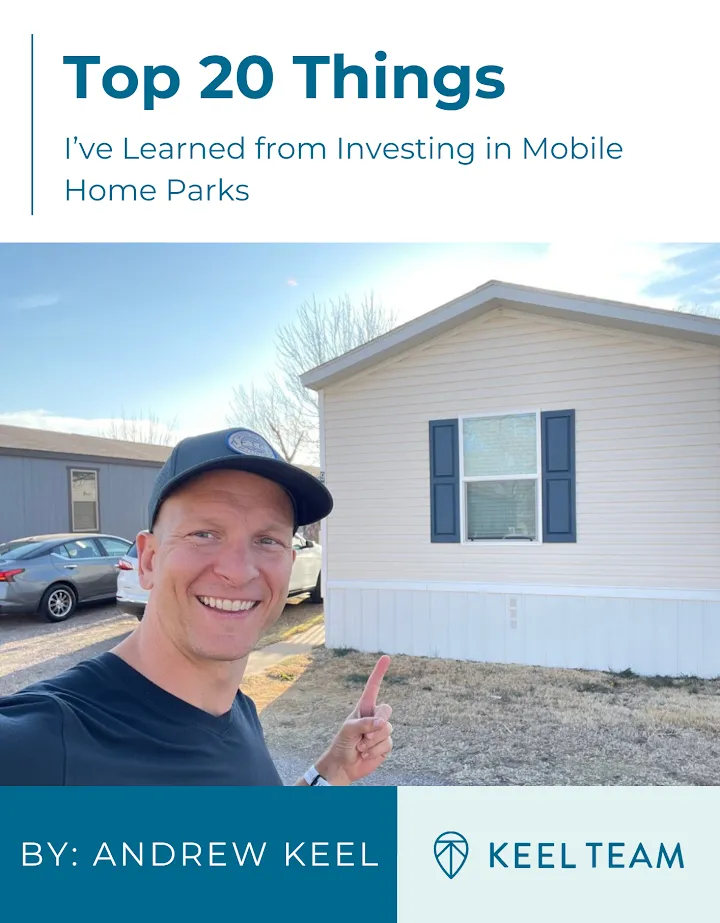
Our free guide covers the top 20 lessons learned from investing in mobile home parks — including the financial mistakes to avoid.
What Determines the Purchase Price of a Mobile Home Park?
Before looking at dollar figures, it helps to understand what drives the price of a mobile home park. Unlike residential real estate, mobile home parks are valued primarily on their income, not comparable sales. The standard valuation formula is:
Net Operating Income (NOI) ÷ Cap Rate = Value
So, the more income a mobile home park generates — and the lower the prevailing cap rate — the higher the price. In 2026, premium mobile home parks are trading at cap rates in the 4%–5% range, while stabilized assets more typically transact between 5% and 7%.
Key factors that tend to influence price include the number of lots and current occupancy rate, monthly lot rent, whether utilities are public or private (private utilities generally reduce value), location and local market demand, and the condition of roads, infrastructure, and amenities.
Typical Purchase Price Ranges
Small Mobile Home Parks (20–50 Lots)
A smaller mobile home park with 20 to 50 lots might typically be acquired somewhere in the range of $500,000 to $2 million, depending on location and condition. These tend to attract individual investors and first-time buyers looking to enter the asset class at a manageable scale.
Mid-Size Mobile Home Parks (50–150 Lots)
Mid-size mobile home parks generally fall in the $1.5 million to $10 million range. As a real-world example, a 138-lot mobile home community was acquired in 2025 for approximately $11.5 million — reflecting the premium investors now place on stabilized, well-located assets.
Large and Institutional-Grade Mobile Home Parks (150+ Lots)
Larger mobile home parks and institutional portfolios can run from $10 million to well above $50 million. Institutional and private equity capital continues to support competitive pricing, with recent transactions indicating that well-marketed assets can achieve pricing 8%–15% above initial expectations.
How Much Do You Need as a Down Payment?
Buying a mobile home park is a commercial transaction, which means the financing landscape differs significantly from residential real estate. Generally, you could expect the following:
- Down payment: Typically 20%–30% of the purchase price for a conventional commercial loan
- Loan terms: Usually shorter than residential mortgages, often with balloon payments
- Seller financing: A common and often more flexible option, particularly for smaller mobile home parks
For a $1 million mobile home park, you might realistically need $200,000–$300,000 in cash to close, plus reserves for operating capital and any immediate capital improvements.
Hidden Costs to Factor In
The purchase price is just one piece of the equation. Before finalizing any deal, you should also budget for the following.
Due Diligence Costs
Environmental assessments, property inspections, surveys, and title searches can collectively run $5,000–$20,000 or more, depending on the size of the mobile home park.
Infrastructure and Capital Expenditures
Roads, utility lines, and aging infrastructure can require meaningful investment. This is increasingly a differentiating factor between value-add and stabilized mobile home parks in 2026.
Property Management
The expense ratio for a professionally managed mobile home park typically runs 30%–40% of gross income — notably lean compared to most multifamily properties.
Is a Mobile Home Park a Good Investment?
The numbers suggest it can be. National mobile home park occupancy currently sits at approximately 94.9%, with asking rents trending higher by 7% over the past year to an average of $752 per month. Meanwhile, transaction activity has been recovering strongly, with sales velocity in the first half of 2025 outpacing the same period of 2024 by 66%.
Additionally, it may offer meaningful tax advantages to buy a mobile home park. Land improvements can potentially depreciate over 15 years — faster than the 27.5-year schedule for standard residential properties — and cost segregation strategies may further accelerate depreciation benefits.
Of course, no investment is without risk. Financing can be harder to secure than with residential properties, regulatory scrutiny around rent increases is growing, and infrastructure costs in aging mobile home parks can be significant. As with any investment, thorough due diligence is essential.
Final Thoughts
So, how much does it cost to buy a mobile home park? Realistically, entry-level deals may start around $500,000, while mid-size and larger assets can run into the tens of millions. Your down payment will likely range from 20%–30%, and you should budget for due diligence, potential infrastructure upgrades, and ongoing management costs on top of that.
What makes mobile home park investing compelling is that the fundamentals remain strong — tight supply, rising demand for affordable housing, and relatively predictable cash flows. For investors willing to do the research, mobile home parks may represent one of the more resilient opportunities in commercial real estate right now.
Our free guide covers the top 20 lessons learned from investing in mobile home parks — including the financial mistakes to avoid.
If you’re interested in learning more about mobile home park investing, reach out and we’ll set up a call. We’re happy to share what we’ve learned from acquiring and operating communities across the country.
Disclaimer:
The information provided is for informational purposes only and is not investment advice or a guarantee of any kind. We do not guarantee profitability. Make investment decisions based on your research and consult registered financial and legal professionals. We are not registered financial or legal professionals and do not provide personalized investment recommendations. This article was written with the help of AI and reviewed by Andrew’s team. Always consult a licensed professional before investing.