How to Invest in Mobile Home Parks: A Step-by-Step Guide
If you are ready to invest in mobile home parks, this step-by-step guide walks you through everything from initial education to making your first investment. Whether you plan to buy and operate a mobile home park yourself or invest passively alongside an experienced operator, the path to getting started is more straightforward than most people realize.
Mobile home parks have delivered some of the strongest risk-adjusted returns in commercial real estate, with structural advantages including limited new supply, recession-resilient demand, and low operating costs. Here is exactly how to invest in mobile home parks, step by step.
Step 1: Educate Yourself on the Asset Class
Before committing capital, invest time in understanding how mobile home parks work as an investment. This means learning the fundamentals of lot rent, the land-lease model, how mobile home park valuations work, and why the asset class has attracted increasing institutional interest.
Key concepts to understand:
- Net Operating Income (NOI): Total revenue minus operating expenses — the primary driver of property value in commercial real estate.
- Cap rate: NOI divided by property value. Mobile home parks typically trade at 6-10% cap rates depending on market and condition.
- Lot rent: The monthly amount residents pay for the land their home sits on. This is the core revenue stream.
- Tenant-owned vs. park-owned homes: The ratio of tenant-owned to park-owned homes significantly impacts operating costs and risk profile.
- Value-add strategies: How operators increase property value through rent optimization, occupancy improvements, utility bill-backs, and infrastructure upgrades.
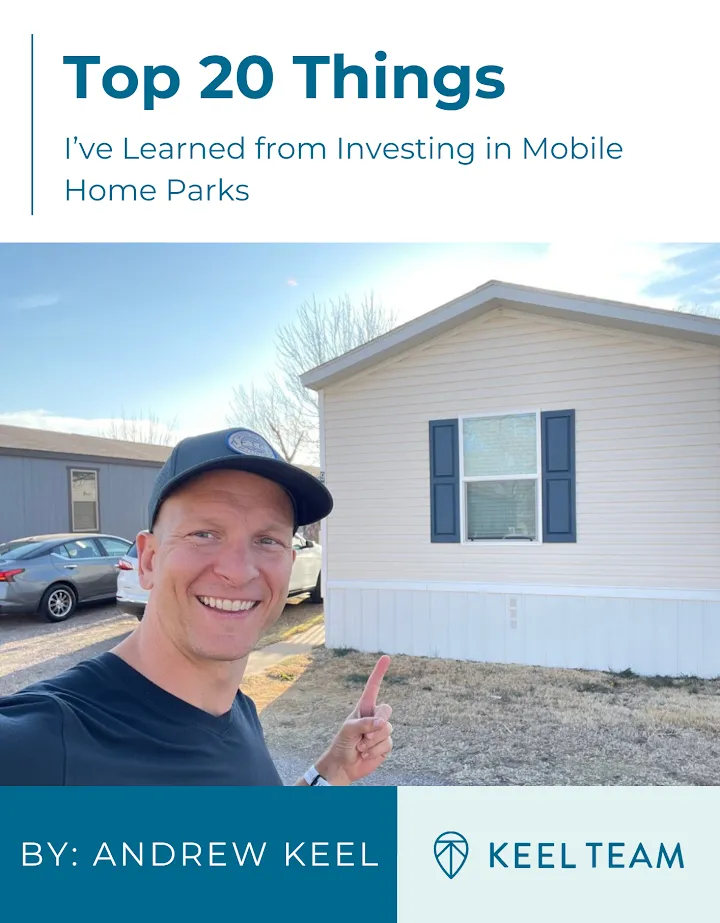
Resources for education include industry publications, podcasts (including the Passive Mobile Home Park Investing podcast), free guides like our Top 20 Things I’ve Learned eBook, and networking with experienced operators and investors.
Step 2: Decide Between Active and Passive Investing
This is the most important decision you will make, and it will shape your entire approach to mobile home park investing:
Active Investing: Buying and Operating Parks Yourself
Active investing means you find, acquire, finance, and operate mobile home parks directly. You are the owner-operator. This path offers the highest potential returns but requires:
- Significant time commitment (especially in the first 1-2 years)
- Capital for down payments and reserves (typically $100,000+)
- Willingness to manage complex operations or build a team to do so
- Understanding of property management, resident relations, and regulatory compliance
- Ability to source deals, negotiate acquisitions, and arrange financing
Passive Investing: Investing Alongside an Experienced Operator
Passive investing means you invest capital into a mobile home park syndication managed by a General Partner (GP) who handles all operational aspects. You are a Limited Partner (LP). This path is ideal if you:
- Have capital to deploy but limited time for property management
- Want real estate exposure without becoming a landlord
- Prefer to leverage an experienced operator’s deal flow, expertise, and management infrastructure
- Value the tax benefits of real estate investing (depreciation, cost segregation) without active involvement
- Want diversification across multiple properties and markets
Many successful investors eventually do both — starting with passive investments to learn the asset class, then transitioning to active acquisitions as they build knowledge and confidence.
Step 3 (Active Path): Finding Deals, Due Diligence, and Financing
If you are pursuing the active path, here is what the deal pipeline looks like:
Finding Deals
The best mobile home park deals are typically found off-market — directly from owners who are ready to sell but have not listed their property. Strategies for sourcing deals include:
- Direct outreach: Cold calling, direct mail, or emailing park owners. At Keel Team, we make approximately 260 cold calls per year to commercial property owners as part of our acquisition strategy.
- Broker relationships: Building relationships with commercial real estate brokers who specialize in manufactured housing.
- Industry networks: Attending industry events, joining mobile home park investing communities, and connecting with other operators.
- Online listings: Platforms like LoopNet, Crexi, and MHVillage list mobile home parks for sale, though these tend to be fully marketed (and therefore more competitively priced).
Due Diligence
Due diligence for mobile home park acquisitions is extensive and critically important. A thorough process should include:
- Physical inspection of all infrastructure (water, sewer, electrical, roads)
- Rent roll verification against bank deposits
- Title search and zoning confirmation
- Environmental assessment (Phase I at minimum)
- Market analysis (comparable lot rents, population trends, employment)
- Financial audit of trailing 12-24 months of operations
- Review of park-owned vs. tenant-owned home breakdown
- Utility system assessment and capital expenditure projections
At Keel Team, our due diligence checklist exceeds 350 items — a reflection of the lessons learned from acquiring and operating over 59 manufactured housing communities. Cutting corners on due diligence is the fastest way to turn a good opportunity into an expensive mistake.
Financing
Common financing options for active mobile home park acquisitions include:
- Local and regional bank loans: Often the best option for first-time buyers and smaller deals. Build relationships with community banks that understand manufactured housing.
- Agency financing (Fannie Mae/Freddie Mac): For larger, stabilized properties. Offers favorable terms but has stricter qualification requirements.
- Seller financing: Common in off-market deals. Can provide flexible terms and lower closing costs.
- Private capital: Partners, family offices, or syndicated capital from investors.
Step 3 (Passive Path): Finding Operators and Vetting Syndications
If you are pursuing the passive path, your deal pipeline is about finding the right operator, not the right property:
Finding Operators
- Research operators with verifiable track records in mobile home park investing
- Look for operators who manage properties internally (not through third-party managers)
- Attend industry events and webinars to meet operators in person
- Ask for references from existing investors
- Review case studies and documented results
Vetting a Syndication
Before investing in any syndication, thoroughly review:
- The Private Placement Memorandum (PPM): This legal document outlines the deal structure, risks, fees, and terms.
- Projected returns vs. actual historical returns: Ask the operator for their actual track record on previous deals, not just projections on the current one.
- Fee structure: Understand all fees — acquisition fees, asset management fees, disposition fees, and the GP’s promoted interest structure.
- Preferred return: What annual return must LPs receive before the GP earns promoted interest? This protects investors and aligns incentives.
- GP co-investment: Is the operator investing their own money alongside yours?
- Communication and reporting: How often will you receive updates? What level of detail? Read investor testimonials to gauge the experience of working with a specific operator.
Step 4: Underwriting Basics
Whether you are buying a park yourself or evaluating a syndication, you need to understand basic underwriting principles:
Revenue Analysis
- Current lot rent × occupied lots = gross lot rent revenue
- Compare current lot rent to market comparables — if below market, there is room for increases
- Factor in other income: utility bill-backs, storage rentals, laundry, home sales
- Apply a vacancy and collection loss factor (typically 5-10%)
Expense Analysis
- Property taxes, insurance, utilities (if not billed back), management, maintenance, administrative costs
- A well-run mobile home park with tenant-owned homes should operate at 35-45% expense ratio
- Watch for unreported expenses or below-market management costs in seller-provided financials
NOI and Valuation
- NOI = Gross Revenue – Operating Expenses
- Property Value = NOI ÷ Cap Rate
- Understand that every dollar of NOI increase translates to $10-15 of property value increase at typical cap rates
Return Projections
- Cash-on-cash return = Annual Cash Flow ÷ Total Cash Invested
- Internal Rate of Return (IRR) factors in the timing and magnitude of all cash flows, including the exit
- Equity multiple = Total Distributions ÷ Total Capital Invested
Step 5: Making Your First Mobile Home Park Investment
For Active Investors
Once you have identified a deal, completed due diligence, and secured financing:
- Finalize your business plan with specific milestones and timelines
- Close the acquisition and begin implementing improvements
- Build your management team or engage qualified on-site staff
- Focus on the highest-impact value-add strategies first: lot rent optimization, utility bill-backs, and filling vacant lots
- Establish systems for financial reporting, rent collection, and maintenance management
For Passive Investors
Once you have selected an operator and reviewed the deal documentation:
- Complete the subscription agreement and wire your investment
- Receive confirmation and onboarding materials from the operator
- Monitor quarterly reports and distribution statements
- Stay engaged — read updates, attend investor calls, and ask questions
- Plan for tax implications with your CPA (K-1 forms arrive annually)
Common Mistakes to Avoid
Whether you are investing actively or passively, these are the most common pitfalls:
- Skipping due diligence: The most expensive mistake in mobile home park investing is buying a property without thorough investigation. Infrastructure surprises alone can turn a profitable deal into a money pit.
- Overestimating revenue growth: Be conservative with rent increase assumptions. Markets have limits, and aggressive rent hikes can increase turnover and community pushback.
- Underestimating capital needs: Always maintain adequate reserves for unexpected repairs, vacancy, and market fluctuations. Undercapitalized deals fail even when the fundamental strategy is sound.
- Choosing the wrong operator (passive investors): An operator’s track record matters more than the projected returns on a specific deal. Investigate the operator as thoroughly as you would the property.
- Ignoring market fundamentals: A beautifully operated mobile home park in a market with declining population and no employment base faces headwinds that operations alone cannot overcome.
- Trying to do everything alone: Mobile home park investing benefits enormously from experienced partners, mentors, and professional service providers. The learning curve is steep, and the cost of mistakes is high.
Getting Started
Keel Team Real Estate Investments is one of the most active mobile home park operators in the country. With over $200 million in assets under management, 59 communities in 15+ states, 3,750+ lots, and 35 full-cycle deals, we have the track record and infrastructure to support both active and passive investors.
Our team of 84 professionals handles every aspect of operations — from acquisitions and due diligence to day-to-day management and hands-on operations.
For those with operational experience in the manufactured housing space, we are always open to conversations about the industry.
Frequently Asked Questions About Investing in Mobile Home Parks
How much money do I need to invest in mobile home parks?
For active investing, plan on at least $100,000-$250,000 for a down payment and reserves on a smaller community. For passive investing through syndications, minimum investments typically range from $50,000 to $100,000 depending on the deal.
Is mobile home park investing risky?
All investments carry risk. Mobile home parks have structural advantages — limited supply, essential demand, low operating costs — that mitigate some risks common in other asset classes. However, poor due diligence, bad operators, or unfavorable market conditions can still lead to losses. The best risk mitigation is choosing experienced operators with proven track records.
How long until I see returns from a mobile home park investment?
Passive investors in syndications typically begin receiving quarterly distributions within the first 3-6 months after acquisition. Active investors may see cash flow immediately if they acquire a stabilized property, or it may take 6-12 months to implement value-add strategies and stabilize operations.
Can I invest in mobile home parks through my self-directed IRA or 401(k)?
Yes. Many passive investors participate in mobile home park syndications using self-directed IRAs or Solo 401(k) plans. These retirement accounts can invest in alternative assets like real estate syndications, and the income and gains grow tax-deferred (Traditional IRA) or tax-free (Roth IRA). Work with a custodian that specializes in self-directed retirement accounts.
What states are best for mobile home park investing?
The best markets combine affordable land, growing population, stable employment, landlord-friendly regulations, and lot rents with room for organic growth. Markets in the Midwest, Southeast, and parts of the Mountain West have historically offered strong fundamentals for mobile home park investments.
How do I know if a mobile home park deal is overpriced?
Compare the asking price per lot to recent comparable sales in the market. Evaluate the cap rate based on actual (not pro forma) NOI. If the seller is pricing based on projected rents or future occupancy rather than current performance, apply appropriate discounts. Be especially careful in competitive markets where bidding wars can push prices above rational investment metrics.
About Keel Team
Keel Team is an experienced mobile home park operator with 35 full-cycle deals and $200M+ in assets under management. We are committed to transparency and operational excellence across every community we manage.
