Miami, FL — Mobile Home Park Investments
Miami, Florida — the seat of Miami-Dade County and the economic and cultural capital of South Florida — represents one of the most dynamic and challenging housing markets in the United States for manufactured housing investors. With a population of approximately 450,000 in the city proper and over 6.4 million in the broader Miami metropolitan area, Miami’s extraordinary housing affordability crisis has created persistent, structural demand for manufactured housing communities serving cost-burdened households across the income spectrum.
Miami Market Overview
Miami’s housing market has undergone a dramatic transformation since 2020. Driven by in-migration from high-tax northeastern states, a surge in remote workers and financial industry relocations, and a chronic undersupply of housing at every price point, Miami’s median home prices have risen over 60% in five years. As of 2025, the median single-family home in Miami-Dade County exceeds $600,000, and apartment rents for a two-bedroom unit average $2,400–$3,200 in the city. Miami consistently ranks as one of the least affordable housing markets in the country relative to local incomes — a dynamic that makes manufactured housing communities critically important for the city’s large working-class population in healthcare, hospitality, construction, and service industries.
The Miami MSA’s population continues to grow, driven by domestic migration and a steady influx of Latin American and Caribbean immigrants. This demographic growth further tightens an already undersupplied housing market and reinforces demand for all attainable housing alternatives, including mobile home parks.
Why Miami for Manufactured Housing Investment
Miami’s affordability crisis is the investment thesis. With conventional housing effectively inaccessible to a large share of the city’s workforce, mobile home parks provide an irreplaceable affordability anchor. Well-operated communities in Miami-Dade County serve long-tenured resident populations who have limited alternatives — low vacancy and consistent rent collection characterize the best-managed parks in the market. On the supply side, Miami-Dade’s urban density and high land values make new mobile home park development impossible, locking in the existing inventory’s competitive position indefinitely.
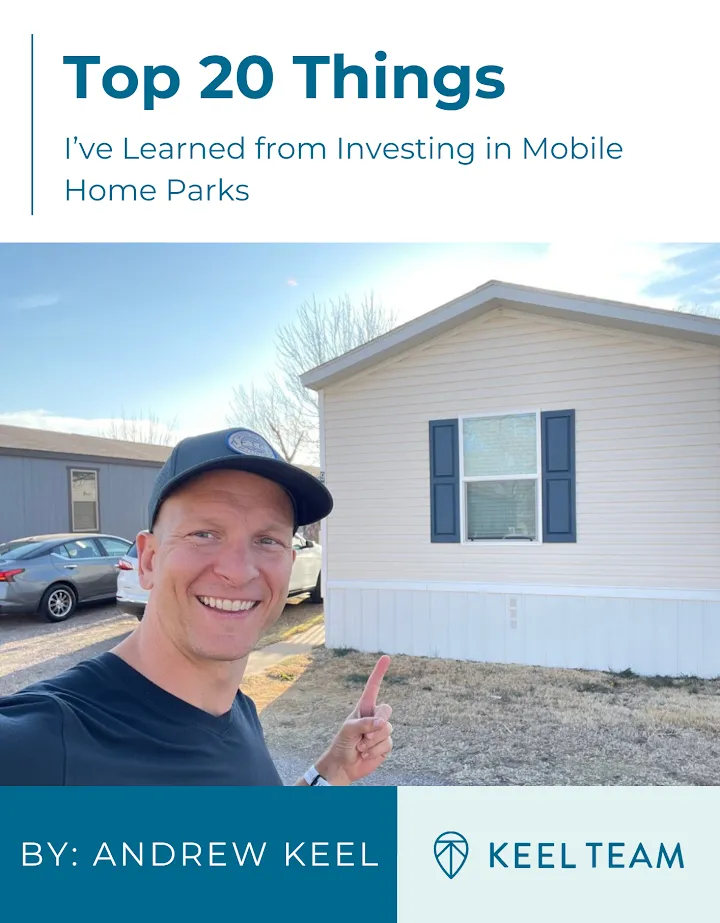
📘 Free Resource: 20 Things Learned from Mobile Home Park Investing
Andrew Keel has distilled years of hands-on operating experience into a free educational guide covering the most important lessons from mobile home park investing across multiple states. Practical, direct, and completely free.
Local Lot Rent Data and Trends
Lot rents in Miami-Dade County mobile home parks range widely based on location, infrastructure, and community quality. Current market rates typically run $900 to $1,300 per month for standard occupied lots, with well-located communities along major transit corridors or near employment centers commanding the upper end. Annual increases of 5–8% have been common in recent years, driven by Miami’s broader housing inflation. The gap between lot rents and conventional apartment rents in Miami is extreme — often $1,000–$1,500 per month — which means manufactured housing communities provide extraordinary affordability value to residents and consistently maintain full or near-full occupancy.
Zoning and Permitting Landscape
Miami-Dade County’s dense urban development pattern and high land values have effectively prevented any new mobile home park construction for decades. Existing parks operate under legacy zoning, typically in areas that were developed before Miami-Dade’s current comprehensive development master plan. The county’s regulatory environment is complex, and investors should engage experienced local land-use counsel to understand the specific zoning classification, allowable uses, and any redevelopment risk for target properties. Miami-Dade has a history of mobile home park redevelopment pressure — parks in high-land-value locations may face long-term pressure from owners seeking higher-value land uses.
Infrastructure: City Water and City Sewer
Miami-Dade County’s water and wastewater service is provided by Miami-Dade Water and Sewer Department (WASD), one of the largest water utilities in the southeastern United States. Most established mobile home parks in the county are connected to WASD infrastructure. Investors should verify connection type and status, as some older parks in transitional neighborhoods may have partial or non-standard connections that require capital investment. Miami-Dade’s proactive sea-level-rise infrastructure planning is also relevant for park owners in lower-elevation coastal communities.
Proximity to South Florida Employment Centers
Miami is a dense, economically diverse city with employment anchors in international banking and finance (Brickell financial district), healthcare (Jackson Memorial Hospital, University of Miami Health System), hospitality and tourism (South Beach, Wynwood), international trade (Port Miami and Miami International Airport), and a growing technology sector. Miami-Dade County’s public transit network — Miami-Dade Transit buses, Metrorail, and Metromover — provides connectivity to key employment corridors. Parks located near Metrorail stations have a meaningful commuter access advantage that supports both occupancy and rent growth.
Frequently Asked Questions
Is Miami a good market for mobile home park investing?
Miami offers extraordinary demand fundamentals — an acute affordability crisis, a large working-class population base, zero new supply pipeline, and consistent rent growth. The challenges are acquisition pricing (reflective of those fundamentals), land-value redevelopment risk for parks in prime locations, and regulatory complexity. Investors with a long-term hold orientation and willingness to navigate a complex market can find strong risk-adjusted opportunities.
What are lot rents in Miami, FL mobile home parks?
Current lot rents in Miami-Dade County range from approximately $900 to $1,300 per month for standard occupied lots, with location, infrastructure quality, and community management driving the variation. Premium communities in stronger locations may exceed this range.
What are the risks of mobile home park investing in Miami?
Key risks include land-value redevelopment pressure (owners may prefer to sell for conversion to higher-density uses), hurricane and flood exposure (Miami-Dade is a high-risk coastal market), regulatory complexity, and high acquisition costs. Flood zone classification and insurance cost are critical due diligence items for any Miami-area park acquisition.
How do I find off-market mobile home parks in Miami-Dade County?
Direct outreach to park owners through targeted direct mail, cold calling, and engagement with local manufactured housing brokers is the most effective approach. The Florida Manufactured Housing Association (FMHA) maintains industry contacts that can assist in identifying ownership. Miami-Dade County property appraiser records are also a valuable research tool for identifying park locations and ownership.
📘 Free Resource: 20 Things Learned from Mobile Home Park Investing
Andrew Keel has distilled years of hands-on operating experience into a free educational guide covering the most important lessons from mobile home park investing across multiple states. Practical, direct, and completely free.