How Much Does It Cost to Buy a Mobile Home Park in 2026?
Andrew Keel
[wpbread]
If you’ve been researching real estate investments and landed on mobile home parks, one of the first questions you probably have is: how much does it cost to buy a mobile home park? It’s a fair question — and the answer involves more than just the sticker price.
Mobile home park investing has attracted significant attention in recent years because of strong cash flow, recession resilience, and favorable supply-demand dynamics. But before you start shopping, you need a clear picture of every dollar involved in an acquisition. Let’s walk through it.
The Purchase Price: What Mobile Home Parks Actually Sell For
Mobile home park purchase prices vary enormously depending on location, size, occupancy, and infrastructure. Here are some realistic ranges you’ll see in the market in 2026:
Small parks (20-50 lots): $500,000 to $3 million
Mid-size parks (50-100 lots): $2 million to $8 million
Large parks (100-250+ lots): $8 million to $30 million+
The primary driver of mobile home park pricing is net operating income (NOI) divided by the prevailing cap rate for the market. In strong metro areas with city utilities, you’ll see cap rates in the 5.5% to 7% range. In more rural locations or parks requiring significant work, cap rates can stretch to 8% to 10%+.
For example, a 75-lot mobile home park with 60 occupied lots charging $350/month in lot rent with a 40% expense ratio would generate roughly $151,200 in NOI. At a 7% cap rate, that park would be valued at approximately $2.16 million.
Closing Costs on a Mobile Home Park Acquisition
Just like any commercial real estate transaction, buying a mobile home park comes with closing costs. Budget for roughly 2% to 5% of the purchase price in closing-related expenses. Here’s where that money goes:
Title insurance and search: $2,000 to $15,000+ depending on deal size
Legal fees: $5,000 to $20,000 for purchase agreement review, entity formation, and closing coordination
Lender fees: Typically 1% to 2% origination fee on the loan amount
Survey: $3,000 to $10,000 for an ALTA survey
Recording fees and transfer taxes: Vary by state, usually $1,000 to $5,000
On a $3 million mobile home park acquisition, you should expect to spend $60,000 to $150,000 in total closing costs.
Due Diligence Costs: The Homework Isn’t Free
Thorough due diligence is non-negotiable when buying a mobile home park, and it carries its own price tag. These costs are typically spent before you close — and you may not get them back if the deal falls apart.
Phase I Environmental Assessment: $2,500 to $5,000 (Phase II if needed: $10,000 to $30,000+)
Property Condition Assessment: $3,000 to $8,000
Sewer line camera inspection: $3,000 to $10,000 depending on park size
Water system testing: $1,000 to $3,000
Appraisal: $3,000 to $8,000
Travel and on-site visits: $1,000 to $5,000
All in, expect to spend $15,000 to $40,000 on due diligence for a typical mobile home park acquisition. It’s money well spent — skipping this step is how investors end up with six-figure surprise repair bills.
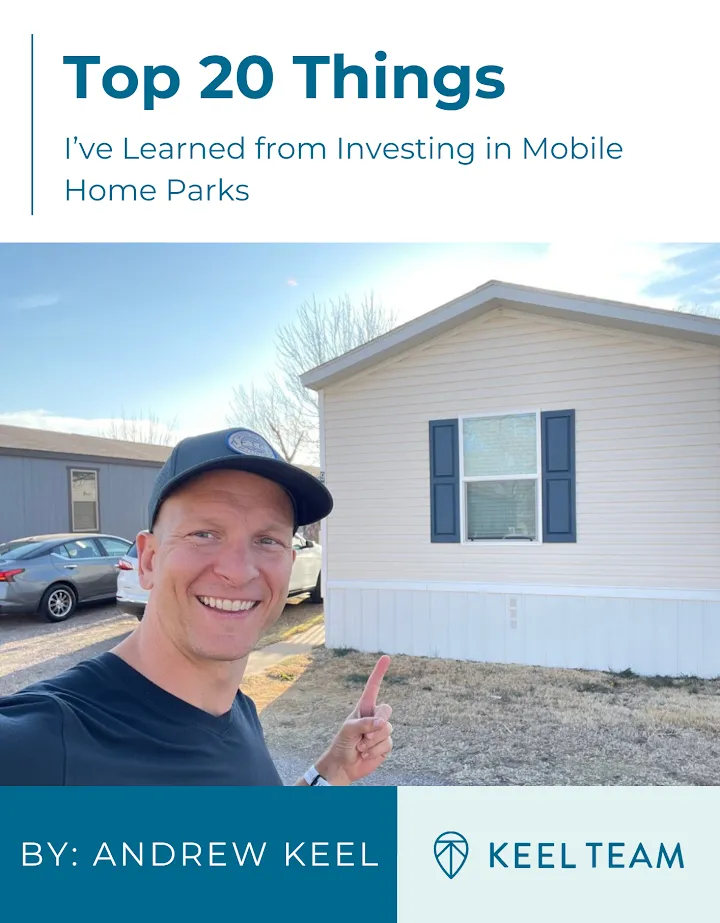
📘 Free eBook: Top 20 Things I’ve Learned from Investing in Mobile Home Parks
Want to learn the lessons we’ve picked up from acquiring and operating mobile home parks across the country? Download our free guide.
Most mobile home park acquisitions are financed, not purchased with all cash. The amount of capital you need upfront depends on your financing strategy:
Conventional/local bank loans: Typically require 20% to 25% down payment
Agency debt (Fannie Mae/Freddie Mac): Usually 20% to 25% down, but with better terms and longer amortization
Seller financing: Can be as low as 10% to 20% down, negotiable
SBA loans: 10% to 20% down for qualifying buyers and parks
On a $3 million mobile home park, a 25% down payment means you need $750,000 in equity. If you’re syndicating the deal (pooling capital from multiple investors), the general partner typically contributes 5% to 20% of that equity, with limited partners funding the rest.
Don’t forget ongoing financing costs: interest rates on mobile home park loans in 2026 are generally running in the 6% to 8% range depending on the loan product, borrower experience, and property quality.
Capital Reserves: The Budget Item Most New Investors Forget
Smart mobile home park investors budget capital reserves on top of the purchase price. This is money set aside for immediate improvements and unexpected expenses during the first 12 to 24 months of ownership.
Home repairs or removals: Abandoned or damaged homes cost $3,000 to $8,000 each to remove
Infill homes: New manufactured homes cost $40,000 to $80,000+ installed, used homes $15,000 to $35,000 moved in
Operating shortfall reserve: 3 to 6 months of debt service and expenses
A conservative capital reserve for a 75-lot mobile home park might be $100,000 to $300,000 depending on the condition of the property and your business plan.
Total Cost Summary: Putting It All Together
Let’s use our 75-lot example to build a total cost picture for buying a mobile home park at $2.16 million:
Purchase price
$2,160,000
Closing costs (3%)
$65,000
Due diligence
$25,000
Capital reserves
$150,000
Total project cost
$2,400,000
With a 75% loan ($1,620,000 in debt), you’d need approximately $780,000 in total equity — the down payment plus closing costs, due diligence, and reserves.
That’s the real answer to “how much does it cost to buy a mobile home park.” It’s not just the purchase price — it’s the full capital stack.
Can You Buy a Mobile Home Park With Less Money?
Yes, but it takes creativity and hustle. Some strategies investors use to reduce the upfront capital needed:
Seller financing with lower down payments and flexible terms
Partnering with experienced operators who bring credibility to lenders
Targeting smaller parks in secondary markets where prices are lower
Assuming existing debt when a seller has transferable financing in place
Investing passively through a syndication, where minimums can start at $50,000 to $100,000
Each approach has trade-offs. Seller financing might come with higher interest rates. Smaller parks have less economies of scale. Passive investing means less control. There’s no free lunch — but there are multiple paths to getting into mobile home park investing at different capital levels.
The Bottom Line
Buying a mobile home park in 2026 is a serious capital commitment, but it doesn’t have to be out of reach. The key is understanding the full cost picture — not just the asking price, but closing costs, due diligence, financing, and reserves. Investors who budget accurately and build in appropriate cushion are the ones who execute successfully and avoid nasty surprises.
Whether you’re looking to acquire your first mobile home park or invest passively alongside experienced operators, having a clear financial roadmap is step one.
📘 Want to Go Deeper? Get Our Free eBook
Our free guide covers the top 20 lessons learned from investing in mobile home parks — including the financial mistakes to avoid.
If you’re interested in learning more about mobile home park investing, reach out and we’ll set up a call. We’re happy to share what we’ve learned from acquiring and operating communities across the country.
Andrew Keel
Andrew is a passionate commercial real estate investor, husband, father and fitness fanatic. His specialty is in acquiring and operating manufactured housing communities. Visit AndrewKeel.com for more details on Andrew's story.